
Abstract
The cyclic voltammetric behavior of  on glassy carbon (GC) and gold electrodes in room-temperature ionic liquids, i.e., 1-ethyl-3-methylimidazolium tetrafluoroborate
 and 1-
 -butyl-3-methylimidazolium tetrafluoroborate
 has been examined. A series of two-electron (2e-) and one-electron (1e-) reductions of the
 redox system could be observed at GC electrode. For example, the cathodic and anodic peaks corresponding to the
 redox couple were observed at ca. 0.2 and
 vs a Ag wire quasi-reference electrode, respectively, in
 , while those observed at
 and
 were found to correspond to the
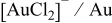 redox couple. The disproportionation reaction of the 2e-reduction product of
 , i.e.,
 to
 and Au metal, was also found to occur significantly. A single reduction peak corresponding to the three-electron (3e-) reduction of
 to Au metal was observed at Au electrode. The electrodeposition of Au nanoparticles was carried out on GC electrode in these ionic liquids containing
 by applying potential-step electrolysis in a different potential range, i.e., the potential was stepped from
 to 0 and
 , at which the reduction of
 to
 and Au, respectively, takes place. The results obtained demonstrate that the electrodeposition of gold may occur via a disproportionation reaction of
 to
 and Au as well as via a series of the reductions of
 to
 and further,
 to Au. The size and morphology of the prepared Au nanoparticles as well as the relative ratio of the Au(111), Au(110), and Au(100) crystalline orientation domains constituting the polycrystalline Au nanoparticles electrodeposited were found to largely depend on the stepped potential (i.e., 0 and
 ). Interestingly, the Au nanoparticles prepared by a potential-step electrolysis from
 are enriched in the Au(110) single-crystalline domain.
Access this article
The computer you are using is not registered by an institution with a subscription to this article. Please choose one of the options below.
Purchase from
Purchase this article from our trusted document delivery partners.

Make a recommendation
To gain access to this content, please complete the Recommendation Form and we will follow up with your librarian or Institution on your behalf.
For corporate researchers we can also follow up directly with your R&D manager, or the information management contact at your company. Institutional subscribers have access to the current volume, plus a 10-year back file (where available).
