
Abstract
We have measured in situ the Ni K‐edge X‐ray absorption spectra of  cathode material charged in a nonaqueous cell. The material was charged to various states of charge (i.e., Li content) which corresponded to x = 0.0, 0.12, 0.24, 0.37, 0.49, and 0.86 in
 . We have determined variations in the Ni‒O and Ni‒Ni coordination numbers, bond lengths, and local disorders as well as the Ni K‐edge energies as a function of Li content. We show that in the pristine state, the composition of the material can be described by the formula
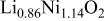 (i.e., x = 0 and
 = 0.14). That is, the material consists of
 (25%) and
 (75%) with half the
 atoms residing in Li sites and the other half in the
 slabs. Upon charging, initially
 is oxidized to
 up to a state of charge which corresponds to x = 2
 . Upon further charging to states corresponding to 2z <x≤1 − z,
 is oxidized to
 with fractions being dependent on the values of x and z. Analysis of the edge energies for NiO, stoichiometric
 , and
 as reference compounds for
 ,
 , and
 , respectively, shows a quadratic dependence for edge energy vs. oxidation state. This type of correlation is consistent with variations observed in earlier studies for some Mn reference compounds in the same range of oxidation states. Oxidation‐state determination of Ni in
 as a function of state of charge (i.e., Li content or x) on the basis of edge energies yielded results which are in excellent agreement with oxidation state determinations made on the basis of the mole fractions for
 ,
 , and
 extracted from extended X‐ray absorption fine structure spectra. © 1999 The Electrochemical Society. All rights reserved.
Access this article
The computer you are using is not registered by an institution with a subscription to this article. Please choose one of the options below.
Purchase from
Purchase this article from our trusted document delivery partners.

Make a recommendation
To gain access to this content, please complete the Recommendation Form and we will follow up with your librarian or Institution on your behalf.
For corporate researchers we can also follow up directly with your R&D manager, or the information management contact at your company. Institutional subscribers have access to the current volume, plus a 10-year back file (where available).
