
Abstract
The growth mechanism and the crystallinity of hydrothermally synthesized nonpolar a-plane ZnO (a-ZnO) on a-plane GaN template were investigated by using epitaxial lateral overgrowth (ELO) patterns parallel or perpendicular to the c-axis direction. Due to the anisotropic growth rates along the specific crystallographic directions, lateral overgrowth of a-ZnO was observed only for ZnO grown on the ELO stripe patterns perpendicular to the c-axis direction. In X-ray diffraction analysis, a-ZnO grown on the c-axis parallel patterns had smaller FWHM values of the X-ray rocking curves along the X-ray in-beam orientations in the c- and the m-axis directions.

This is an open access article distributed under the terms of the Creative Commons Attribution 4.0 License (CC BY, http://creativecommons.org/licenses/by/4.0/), which permits unrestricted reuse of the work in any medium, provided the original work is properly cited.
There has been great interest in nitride-based wide bandgap semiconductors for solid state lighting applications. Commercially available light-emitting diodes (LEDs) are mostly based on gallium nitride (GaN) related material system, which is grown along the polar c-axis [0001] of wurtzite crystal structure on c-plane sapphire substrate. In this crystal plane, there exist the spontaneous and piezoelectric polarizations inducing internal electric fields, which result in spatial separation of electron and hole wave functions.1,2 This quantum confined stark effect causes the reduction in radiative recombination efficiency in quantum well structure.3–5 As an alternative approach, extensive efforts have been exerted to eliminate the internal electric field using nonpolar or semipolar GaN crystals.6–9
ZnO is a promising light-emitting material due to its wide direct bandgap of 3.37 eV and larger exciton binding energy of 60 meV than that of GaN. Various growth methods for ZnO epitaxial layer have been reported such as metal organic chemical vapor deposition, molecular beam epitaxy, pulsed laser deposition, and hydrothermal synthesis.10–14 Among these deposition techniques, hydrothermal growth is one of the most facile and cost-effective methods due to its atmospheric growth pressure and significantly low process temperature. Recently, we have reported nonpolar a-plane ZnO (a-ZnO) film grown on a-plane GaN (a-GaN) template by hydrothermal method, which can act as a light-emitting active layer of nonpolar n-type ZnO/p-type GaN heterostructure LED.2,15 However, the crystal quality of hydrothermally grown a-ZnO has much room for improvement compared with conventional GaN epitaxial layer. The growth mechanism also needs to be further understood. It is generally accepted that epitaxial lateral overgrowth (ELO) technique can successfully enhance material quality of GaN. Crystal defects such as threading dislocations are significantly reduced on the masking area because these dislocations stemming from window region cannot be extended over masked pattern. Since ZnO has the same wurtzite crystal structure as GaN and the similar growth mechanism of island nucleation is involved on lattice mismatched foreign substrates, the ELO technique can be also applied to hydrothermal growth of ZnO.16–19 In this work, we investigated the growth mechanism, and the crystalline and optical properties of hydrothermally-grown a-ZnO films on a-GaN templates using ELO patterns in parallel and perpendicular directions to the c-axis.
5 μm-thick a-GaN epitaxial films were grown on r-plane  sapphire substrates utilizing a two-step growth method by 11 × 2 inch AIX 2400 G3 metal-organic chemical vapor deposition system. ELO patterning process started with deposition of 2000Å of SiO2 on a-GaN films by plasma enhanced chemical vapor deposition at 300°C. Then, stripe patterns aligned to the parallel or perpendicular to the c-axis for each sample were formed by conventional photolithography, and etched by buffered oxide etchant. The widths of spacing and masking area were both 3 μm. Nonpolar a-ZnO film was hydrothermally grown on ELO patterned a-GaN template by a simple aqueous solution method.2 25 mM of zinc nitrate hexahydrate was dissolved in deionized water, and equimolar methenamine solution was mixed together in Teflon-lined autoclave. The substrate was placed in the growth solution at 90°C for 90 min. This growth cycle was repeated to produce thick a-ZnO film.
Fig. 1a and 1b show the SEM images of a-ZnO hydrothermally grown for 450 min. on ELO patterns with stripes in parallel and perpendicular directions to the c-axis [0001], respectively. For a-ZnO sample on the stripe patterns parallel to the c-axis, ZnO films are confined in the ELO window regions, which are distinctively different from those on the stripe patterns perpendicular to the c-axis. The striated surface morphology parallel to the c-axis are observed for both samples in common as shown in Fig. 1c and 1d. Hydrothermal growth of a-ZnO on a-GaN template follows Volmer-Weber (VW) growth model which is also the growth mechanism of vapor phase epitaxy of GaN on sapphire substrate.2,13 Three dimensional islands are formed at the initial growth stage since adatom-adatom interaction is stronger than that of the adatom with GaN surface. These islands continue to grow, and finally cause rough continuous films on the substrate. Only on the a-GaN window area, ZnO island clusters were created, and a-ZnO film lines with coarse surface morphology were formed. In the hydrothermal synthesis of ZnO, the fast growing facets with higher surface energy grow to extinction ultimately while the slow growing planes expand and define the final remaining facets of ZnO. The growth rate of ZnO in the c-axis direction is much faster than the a-axis  and the m-axis
 directions.20,21 Therefore, triangular prismatic ZnO islands having a-plane basal plane grows along the fastest c-axis direction with the slowest growing m-plane facets on inclined sides, and then individual ZnO prisms coalesce together with adjacent prisms. As a result, nonpolar a-ZnO film lines are formed with remaining m-plane facets exposed on ELO window area.2
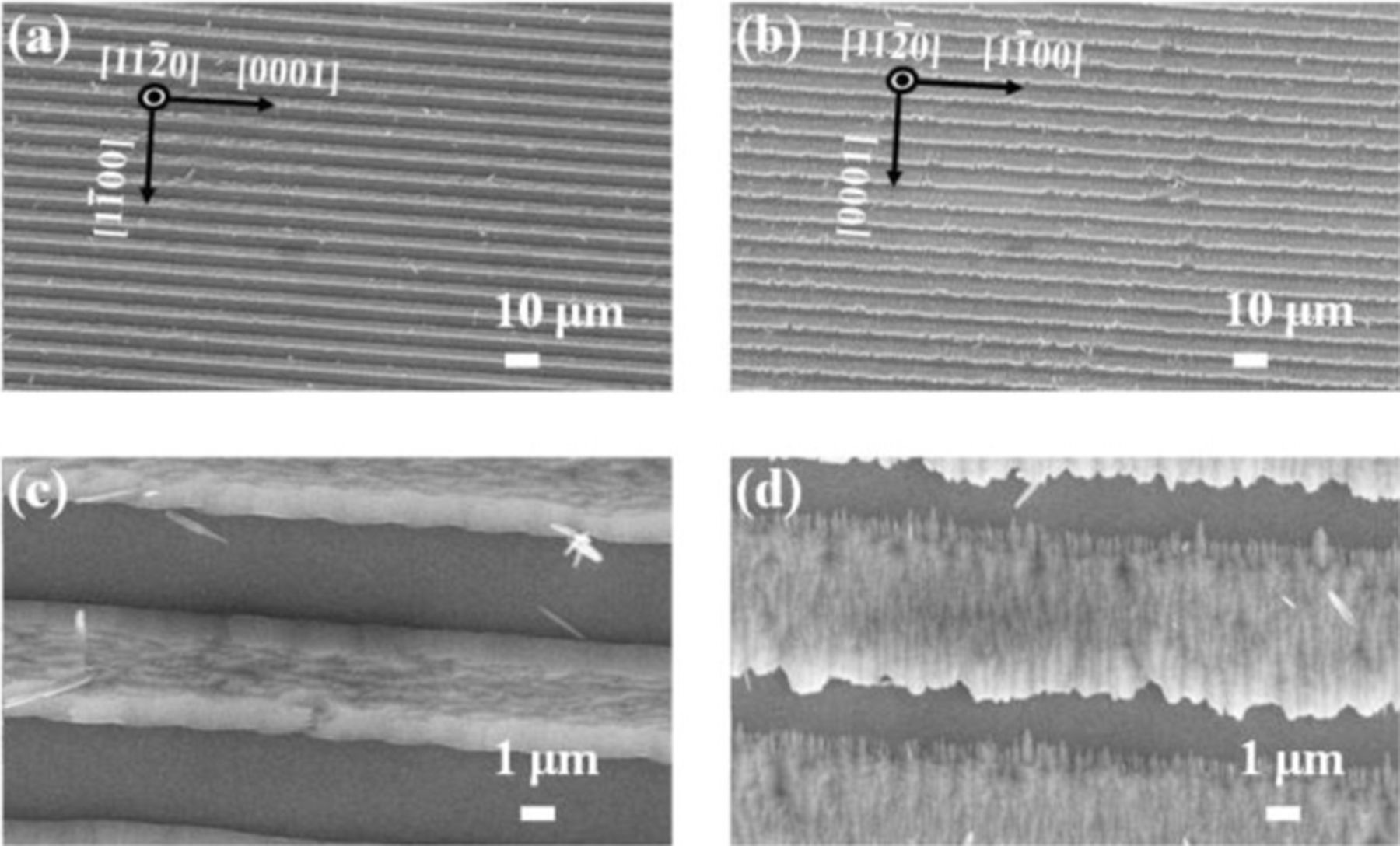
Figure 1. (a) SEM image of the a-plane ZnO grown on the stripe patterns parallel to the c-axis [0001] for 450 min. (b) SEM image of the a-plane ZnO grown on the stripe patterns perpendicular to the c-axis for 450 min. (c), (d) high magnification SEM images of (a) and (b) respectively.
As the growth process proceeds, a-ZnO grew over mask regions and spread to the c-axis direction for a-ZnO on the stripe patterns parallel to the m-axis, as shown in Fig. 2b, 2d, and 2f. On the contrary, dense a-ZnO film lines grown on patterns parallel to the c-axis were still confined on the ELO window area of a-GaN (Fig. 2a, 2c, and 2e). Even after 1800 min. growth, only slight increase of ZnO growth in the a-axis direction was observed for a-ZnO on the stripe patterns parallel to the c-axis, while the gaps between a-ZnO lines were dramatically decreased for a-ZnO grown on the stripe patterns parallel to the m-axis. This difference in ELO growth of ZnO is ascribed to the anisotropic growth rates along the specific crystallographic directions. The fast growth rate of ZnO in the c-axis direction can be relatively modulated by using surfactants such as citrate ions or polyethylenimine in hydrothermal growth solution.13,22
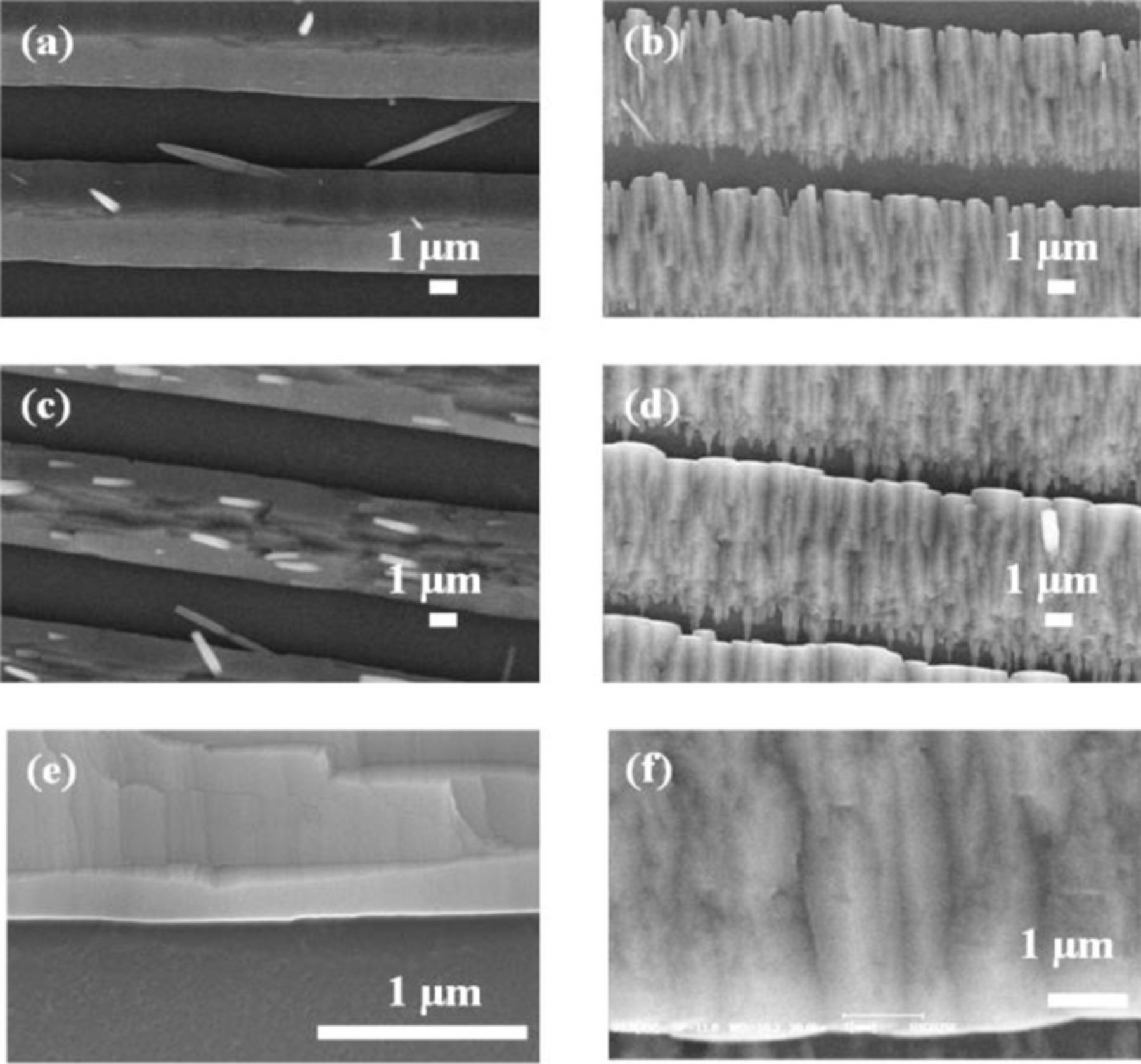
Figure 2. SEM images of the a-plane ZnO grown on the stripe patterns parallel to the c-axis for (a) 900 min. and (c) 1800 min. SEM images of the a-plane ZnO grown on the stripe patterns parallel to the m-axis for (b) 900 min. and (d) 1800 min. (e), (f) high magnification SEM images of (c) and (d).
PL measurement results of a-ZnO on ELO patterns are shown in Fig. 3a and 3b. PL spectra of both samples show a-GaN peak at 359 nm, a-ZnO peak at 375 nm, and green and yellow emissions which are also commonly seen in hydrothermally grown c-plane ZnO due to the oxygen vacancies and hydrogen interstitials.23,24 The a-ZnO grown on the stripe patterns parallel to the c-axis shows much stronger a-GaN peak intensity because the mask regions consisting of a-GaN beneath SiO2 layer was not covered by confined a-ZnO. The intensity ratio of band edge to defect emissions were 0.73 and 0.37 for a-ZnO on ELO patterns parallel and perpendicular to the c-axis direction, respectively. In addition, a-ZnO grown on the stripe patterns parallel to the c-axis exhibits higher absolute PL intensity.
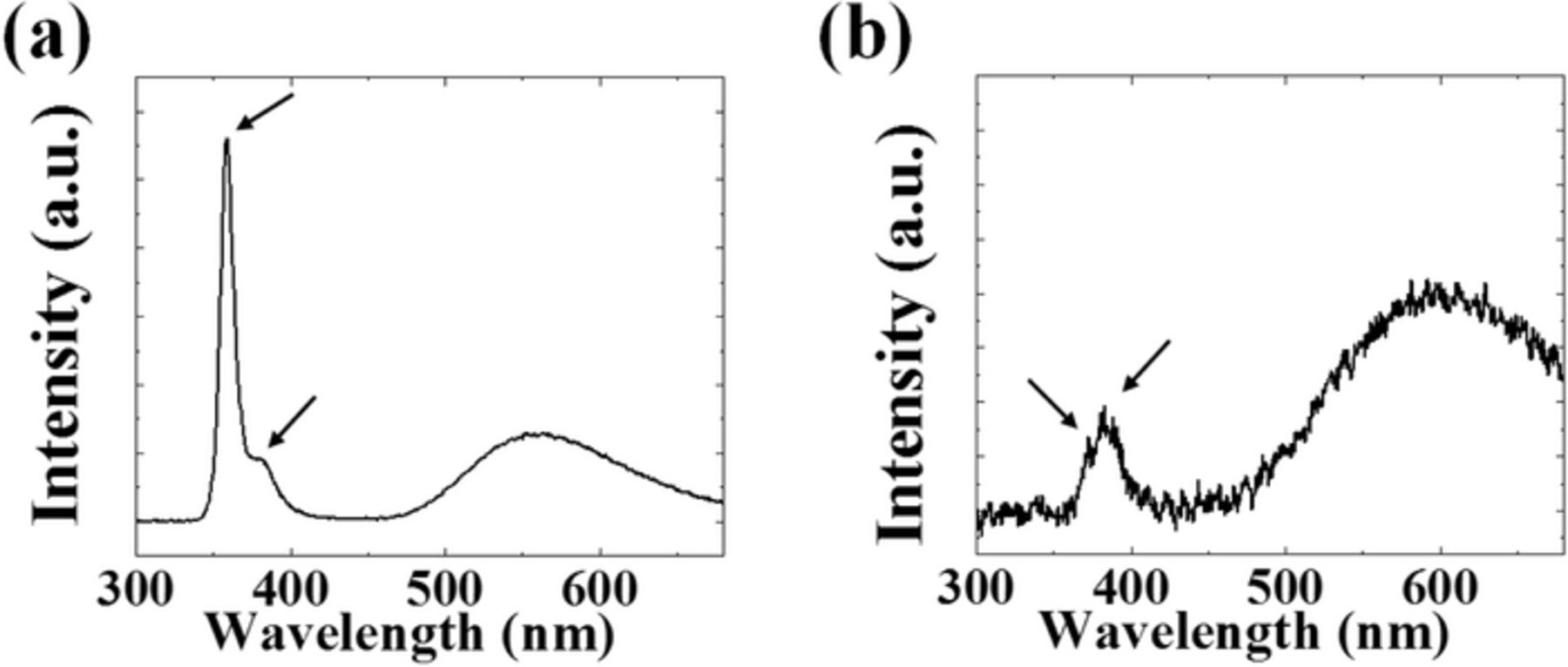
Figure 3. The PL spectra of the a-plane ZnO grown on the stripe patterns (a) parallel and (b) perpendicular to the c-axis.
The structural quality of the ELO a-ZnO grown on the c-axis parallel and perpendicular patterns was evaluated using X-ray diffraction technique as shown in Fig. 4. For both samples, two distinct diffraction peaks of a-ZnO at 2θ = 56.75° and a-GaN at 2θ = 57.85° are observed. The peak intensity of a-ZnO grown on the c-axis parallel patterns was quite similar to that on the c-axis perpendicular patterns. It clearly shows that the nonpolar a-ZnO ELO films were highly crystalline and uniformly a-plane oriented within the sensitivity of the X-ray measurement for both cases. Fig. 5a and 5b show the XRD ω-rocking curves of ELO a-ZnO films with respect to the X-ray in-beam orientations along the c-axis and the m-axis directions. Both a-ZnO films exhibited anisotropic peak broadenings of on-axis rocking curves within the scattering planes. The full width at half maximums (FWHMs) of the on-axis symmetric reflection along the c-axis direction were 1623 arcsec and 1732 arcsec for the c-axis parallel and perpendicular ELO samples, respectively, while those of X-ray in-beam orientations along the m-axis direction were 1286 arcsec and 1505 arcsec. It is worth mentioning that the peak widths of ω-rocking curves were not only smaller along the m-axis direction than those along the c-axis direction, but the peak intensities along the m-axis direction were also considerably higher than those along the c-axis direction, due to a-ZnO films on ELO masking region are highly fragmented and tilted along the c-axis direction.15
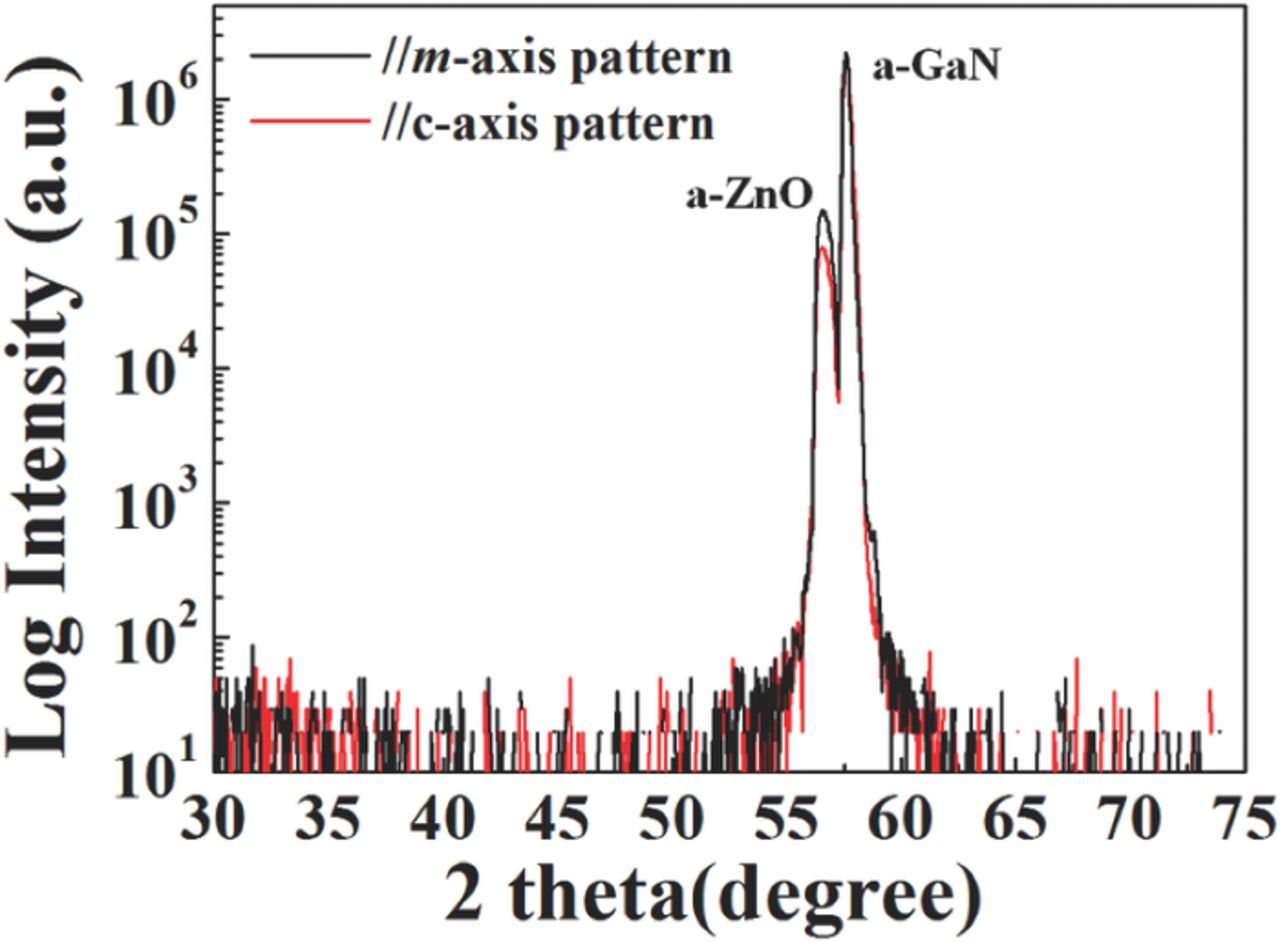
Figure 4. The XRD θ-2θ scans of the a-plane ZnO grown on the stripe patterns parallel to the c- and m-axis directions.
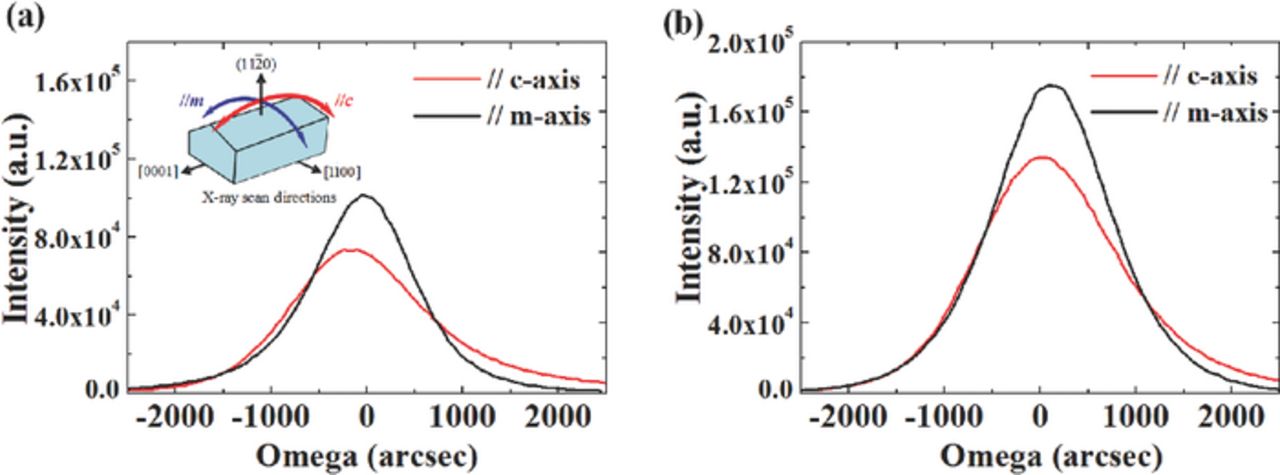
Figure 5. The XRD ω-rocking curves of a-plane ZnO grown on the stripe patterns (a) parallel and (b) perpendicular to the c-axis.
In conclusion, the hydrothermal growth mechanism and material properties of a-ZnO on nonpolar a-GaN films were investigated by using ELO patterns parallel and perpendicular to the c-axis direction. Due to the anisotropic growth rates along the crystallographic directions, lateral overgrowth of a-ZnO was observed only for ZnO samples grown on the ELO stripe patterns perpendicular to the c-axis direction. The PL intensity ratios of band edge to green defect emissions were 0.73 and 0.37 for the c-axis parallel and perpendicular ELO patterned samples, respectively, and a-ZnO grown on the c-axis parallel patterns exhibited higher absolute PL intensity. In the XRD analysis, a-ZnO grown on the c-axis parallel patterns showed smaller FWHM values of the X-ray rocking curves for the X-ray in-beam orientations along the c- and the m-axis, indicating the improved crystalline quality could be obtained for a-ZnO on ELO patterns parallel to the c-axis direction.
Acknowledgment
The present research was conducted by the research fund of Dankook University in 2014.