
Abstract
Herein we demonstrate the improved performance of electrically controlled birefringence (ECB) cells fabricated on solution-derived La2O3 films pre-treated with ion beam irradiation. Treatment by an ion-beam (IB) irradiation system and appropriate annealing temperature allowed La2O3 surfaces to support homogeneous liquid crystal (LC) alignment. The EO characteristics of the aligned homogenous LCs and ECB modes in cells fabricated on La2O3 layers were comparable to those of cells fabricated on polyimide, and IB-irradiated La2O3 film surfaces showed good potential for use as an alignment layer.
Interactions between LC molecules and solid-substrate surfaces are significant in both fundamental research and liquid-crystal display (LCD) applications.1 Various LC surface alignments on indium-tin oxide (ITO)-coated glass substrates can be induced using different surface treatments such as rubbed polymers, oblique SiO films, stacked Langmuir-Blodgett films, UV exposure, and IB bombardment.2–7 The rubbed polymer is a prime candidate for large-area treatment and hence mass production. Unfortunately, rubbing with a cloth produces an electrostatic charge and introduces particle generation issues that make it difficult to attain proper LC alignment. Accordingly, researchers have been strongly motivated to find a non-contact means of obtaining mono-domain LC alignment on substrate surfaces. The use of IB-induced alignment on inorganic and organic surfaces has been intensively studied.6,7,9 More specifically, suitable LC alignment has been attained using a Kaufman-type IB gun to orient LCs on diamond-like carbon (DLC) films.6,7 Many optically transparent and insulating film materials, such as DLC, SiC, SiNx and La2O3 materials have been investigated as potential candidates for inorganic alignment materials.6–11
In this study, we used a La2O3 layer instead of a polyimide (PI) alignment layer to achieve homogeneous alignment of LC molecules via IB irradiation.11 Furthermore, we were able to vary the LC orientations on La2O3 surfaces by varying the solution deposition temperature. Likewise, spectra of La2O3 surfaces with and without IB treatment were analyzed by XPS, allowing us to explain the mechanism of LC alignment. In addition, we measured the EO characteristics of La2O3 cells annealed at various temperatures to allow comparisons with the rubbed PI layer.
La2O3 thin films were prepared by solution processing on ITO-coated glass substrates (Samsung Corning 1737: standard 32 × 22 × 1.1 mm3, sheet resistance 10 Ω □−1). Prior to deposition, the ITO-coated glass substrates were first cleaned by ultrasonication in a solution of trichloroethylene, acetone, methanol, and deionized water solution for 10 min and then dried with N2 gas. Next, lanthanum nitrate hydrate [La(NO3)3•xH2O] and monoethanolamine were dissolved in 2-methoxyethanol. The molar ratio of monoethanolamine to lanthanum nitrate hydrate was maintained at 0.1 mol L−1 while the solution was stirred at 75°C for 2 h and then aged for at least 1 d. The La2O3 solution was spin-coated onto clean ITO-coated glass substrates by a spin coater operated at 3000 rpm for 1 min. The coated glasses were then preheated at 200°C for 10 min to remove any residual solvent. Finally, the films were annealed at various temperatures (200, 300, 400, and 500°C) in a furnace for 1 h.
All IB-treated La2O3 films were irradiated with an Ar+ IB plasma (104 to 105 ions cm−2 at an IB current of 1.6–4.9 mA cm−2) for 3 min at an incident angle of 45° and an irradiation energy of 2400 eV using a DuoPIGatron-type IB system.12 Glass substrates with a La2O3 layer were fabricated in an anti-parallel configuration with a cell gap of 60 μm to observe pretilt angles, and ECB-mode cells were prepared with a cell gap of 2.5 μm to examine optical transmission and response time characteristics. ECB cells were filled with LC (Δn = 0.0946, Δε = 10.7). LC alignment conditions were observed using a polarization microscope (BXP 51, Olympus). The pretilt angle of the nematic LCs (NLCs) on the IB-irradiated La2O3 layer was measured by the crystal rotation method (TBA 107, Autronic) at room temperature. Physical and chemical modifications of the La2O3 films before and after IB irradiation were analyzed using atomic force microscope (AFM; XE-Bio, Park Systems) and XPS (ES-CALAB 220i-XL, VG Scientific). In addition, changes in the surface energies were calculated through the measurement of contact angles (SEO phoenix 300) of the La2O3 surfaces. EO characteristics of ECB cells were measured by an LCD evaluation system (LCMS-200, Sesim).
Figure 1a shows photomicrographs of the fabricated La2O3 films. At annealing temperatures greater than or equal to 300°C, the LC molecules were oriented uniformly and a homogenous LC alignment was observed. The LCs were well-aligned without local defects immediately after the LC cell was fabricated. Otherwise, the images were not uniform and exhibited irregular bright and dark regions, indicating that the LC molecules were in poor alignment
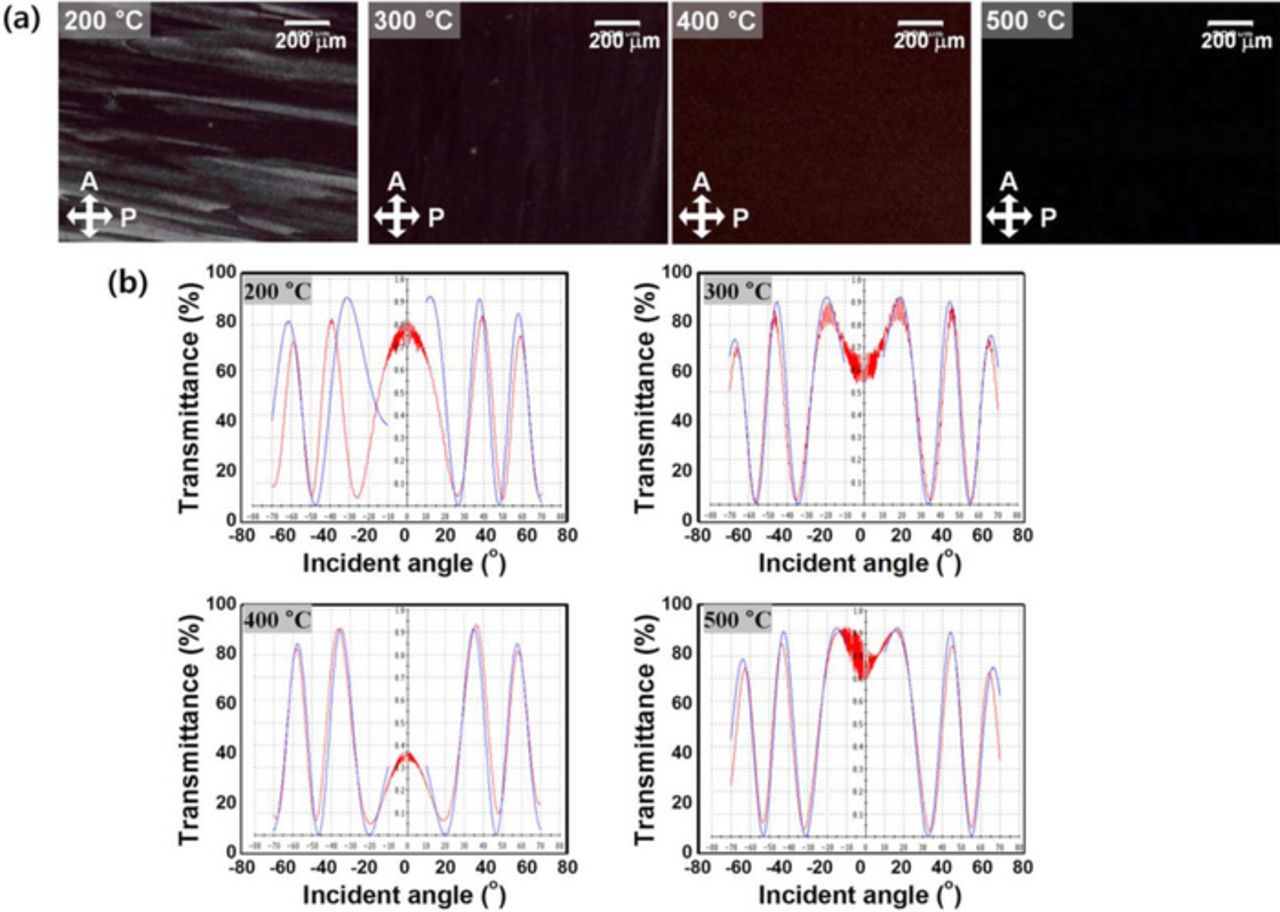
Figure 1. (a) Photomicroscopic images of LC cells annealed at various temperatures. (P: polarizer, A: analyzer). (b) Transmittance versus incident angle obtained from pretilt angle measurements (blue: simulation data; red: experimental data).
As shown in Fig. 1b, transmittance profiles over a range of incident angles from −70° to +70° were collected, and compared to simulations The oscillation of the transmittance was measured by LC cell rotation. The blue line indicates the simulated curve, while the red line is the experimental curve. The measured pretilt angle results indicate that the pretilt angle of the La2O3 films was reliability and uniform LC alignment was achieved.. The pretilt angles of LC molecules on the La2O3 layers were measured as approximately 0.5 degree. These results demonstrated that a regular pretilt angle in the LC molecules produces uniform LC alignment in the LCDs.
To determine the mechanism of LC alignment, we conducted a chemical analysis using XPS. Based on the XPS signal intensity and the measured ITO content, the XPS probe depth was determined to be several nanometers. Figure 2 shows the La 3d portions of the XPS spectra of 50-nm-thick La2O3 film coatings on ITO glass annealed at 200°C and 500°C, which conditions were selected whether uniform LC alignment was achieved or not. In this analysis, the binding energies of the core levels were calibrated by setting the adventitious carbon 1s peak to 284.6 eV.12 The La 3d signals consisted of 3d3/2 and 3d5/2 spin-orbit doublets.13 The La 3d peak positions were consistent with La–O bonding because the La2O3 reference spectrum is 834.92 eV.14 The shapes and binding energy values of the La features agreed with those of standard La2O3 XPS spectra. The interlayer La 3d5/2 peak was observed at 837.6 eV, a higher-energy position than that of the surface peak; we tentatively attribute this to a change of the interlayer composition caused by the IB irradiation.
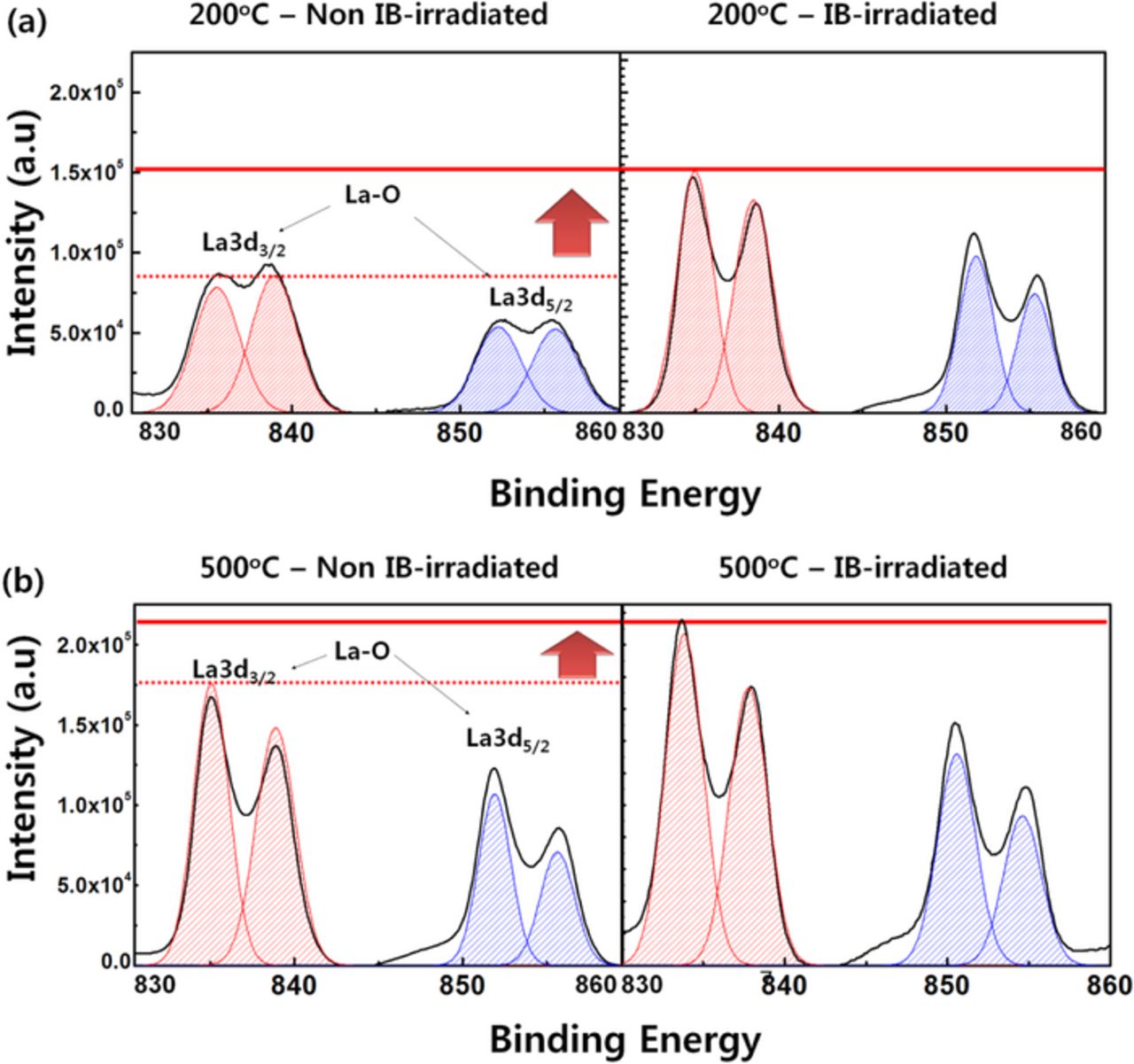
Figure 2. XPS spectra showing the effect of IB irradiation in increasing both the concentration (measured as peak intensity) and binding energy of the La 3d peak. (a) 200°C (b) 500°C.
In addition, the La 3d3/2 and La 3d5/2 peaks of the La2O3 surface changed as a function of temperature. As a result of the La2O3 surface change, which was observed as a uniform alignment state, the La 3d3/2 and La 3d5/2 peaks increased. After IB irradiation, intensity levels of La 3d3/2 peaks were increase 46.2% and 14.2% at 200°C and 500°C, respectively. Specifically, smaller van der Waals interactions between the La2O3 and LC molecules appear to be the cause of the random LC alignments on pre-ion-bombarded La2O3 surfaces. However, when La2O3 surfaces became unstable due to ion bombardment, strong van der Waals interactions arose between the La2O3 surfaces and the LCs; these interactions were stronger than LC molecular interactions and were thus capable of bringing about homogeneous alignment on the La2O3 surfaces.
The surface energy is one of the important factors in controlling the pre-tilt angle on the alignment surfaces. Changes in the surface energies were detected through the measurement of contact angles (SEO Phoenix300) on each growth temperature of the La2O3 surface. The surface energy was calculated using Young equation from the contact angle on the La2O3 surfaces. Figure 3 shows the measured contact angles for LC alignment of both as-coated and IB-irradiated La2O3 films annealed at 200°C and 500°C. Contact angles of DI-water markedly changed when IB irradiated on La2O3 films. Specifically, IB irradiation induces chemical reformation by breaking La-O bonding, leading to uniformly homogeneous LC alignment. The increased van der Waals force between the La2O3 layer and the DI-water due to IB irradiation induces a lower contact angle in the liquid, and this indicates that the La2O3 film has a lower surface energy. The measured contact angles and surface energies of La2O3 films at 500°C before and after IB irradiation were 61.9°, 44.8° and 47.61 mJ/m2, 71.37 mJ/m2, respectively. LC molecules can be applied equally as a liquid; therefore, the LC molecules were uniformly aligned due to the increase in van der Waals force.
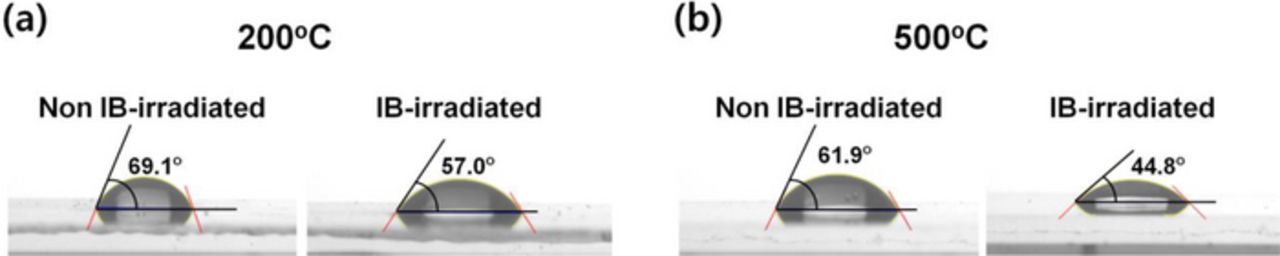
Figure 3. Images showing contact angles on La2O3 films for DI water.
A physical investigation using AFM was performed, as shown in Figure 4. The root mean square (RMS) roughness values of as-coated and IB-irradiated La2O3 films were 7.4 and 9.5 nm, respectively. This morphological change was due to Ar+-induced plasma but does not appear to change the form or shape of the surface, and it is less contributive than chemical reformation to achieving a uniform LC alignment.
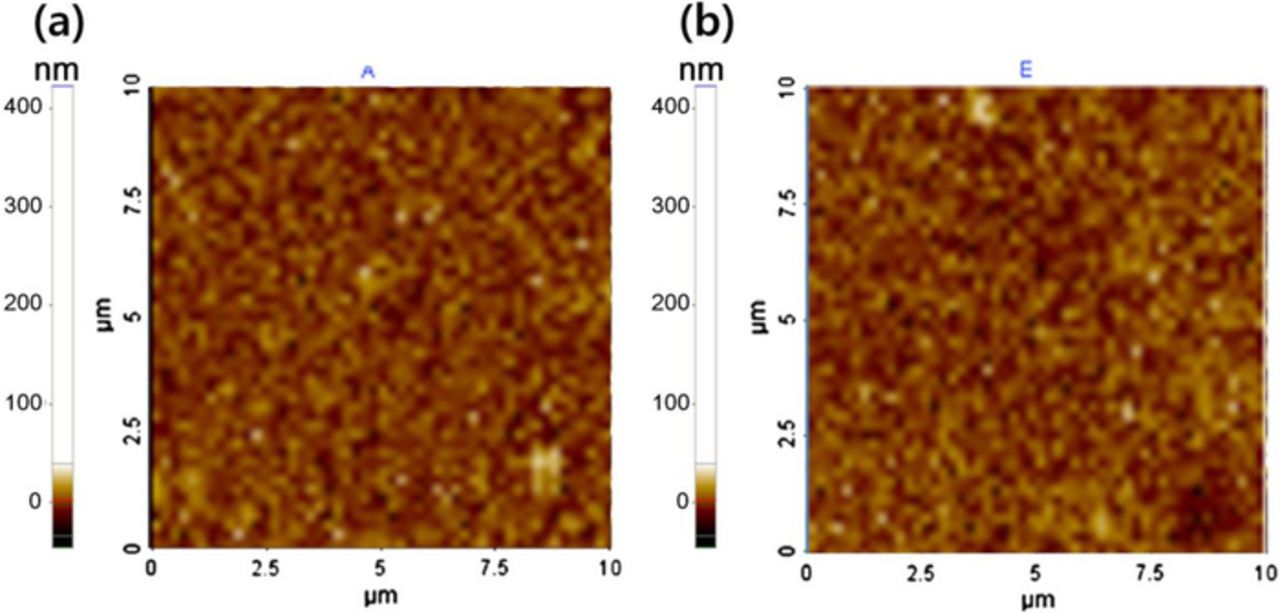
Figure 4. The surface morphology of the as-coated and IB-irradiated La2O3 film.
The electro-optical (EO) characteristics of the ECB mode cells were measured to examine the potential of the La2O3 layers for LCD applications in Fig. 5. The transmittance of the ECB cells corresponded strongly to the behavior of the LC alignment state, as evidenced by voltage-transmittance (V-T) characteristics measured under driving voltage ranging from 0 to 5 V as shown in Fig. 5a. Defining the threshold voltage as that corresponding to 90% transmittance, the threshold voltage of ECB cell fabricated with the La2O3 layer was 1.39 V at 500°C, whereas that of the rubbed PI was 1.98 V. The conventional PI based ECB cell served as a standard of comparison. Taken together, these results indicate that the La2O3 layer has the potential to operate at lower external voltages and to consume less power. Figure 5b shows the response time characteristics of ECB cells fabricated with the La2O3 layers. The ECB cells with the La2O3 layers exhibited rise time of 3.69 ms and fall time of 4.05 ms for the annealing temperature of 500°C. These improved EO characteristics of ECB cell with La2O3 layers was attributed to high dielectric constant (27) of the La2O3 material. Capacitance of La2O3 layer is higher than that of the PI layer, therefore the effective electrical field increase.15,16 This features contribute to improvement of the EO characteristics of ECB cells.
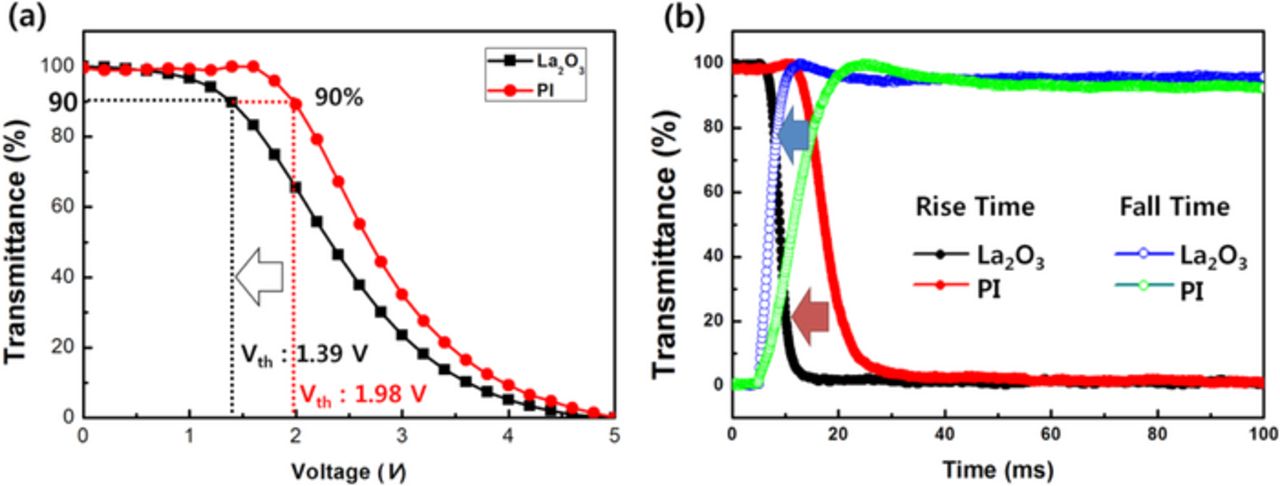
Figure 5. (a) Transmittance spectra of ECB LCDs fabricated on two surfaces: IB-irradiated La2O3 and rubbed PI. (b) Response time characteristics of ECB LCDs fabricated on two surfaces: IB-irradiated La2O3 and rubbed PI.
In the present study, we investigated the homogeneous alignment of LCs on IB-irradiated La2O3 surfaces deposited by means of solution processing, and evaluated the effect of La2O3 concentration upon this alignment. Our results indicate that homogeneous LC alignment was achieved by annealing temperature above 300°C. In addition, curve fitting with XPS indicated that IB irradiation of La2O3 surfaces changed the resulting intensity of the La 3d peaks. Because the reformation of La-O bonding and the modification of La2O3 surfaces play important roles in the homogeneous alignment of LC molecules, it is important to note that LCs deposited on IB-irradiated La2O3 films exhibited faster response times than LCs deposited on rubbed PI, suggesting that La2O3 films are suitable for use in LCD devices.