
Abstract
Hafnium carbonitride  films were synthesized as a metal-gate electrode by metallorganic chemical vapor deposition using
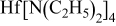
 precursor. The physical and electrical properties, especially the dielectric evolution characteristic of oxide dielectric, were evaluated using X-ray photoelectron spectroscopy, capacitance–voltage, and current–voltage measurements. As a result, the capacitance-deduced equivalent oxide thickness (EOT) becomes much smaller than the initial physical thickness of various oxide dielectrics after
 deposition. For the case of
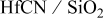 stacks, the reduction in EOTs was attributed to the increase in average effective dielectric constant, possibly due to atoms interdiffusion, e.g., N, Hf, or O atoms, which may promote the formation of high-κ dielectric phases. Based on the dielectric evolution characteristic, although the leakage current in the
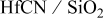 stack with reduced EOT is close to the level of the doped-polysilicon/
 stack, Hf-based metal electrode/high-κ dielectric/Si MOS stacks are also expected to be integrated into thermal oxide/Si stacks by one-step metal electrode deposition, which results in conversion of the
 layer into a high-κ dielectric layer.
Access this article
The computer you are using is not registered by an institution with a subscription to this article. Please choose one of the options below.
Purchase from
Purchase this article from our trusted document delivery partners.

Make a recommendation
To gain access to this content, please complete the Recommendation Form and we will follow up with your librarian or Institution on your behalf.
For corporate researchers we can also follow up directly with your R&D manager, or the information management contact at your company. Institutional subscribers have access to the current volume, plus a 10-year back file (where available).
