
Abstract
A sensor employing yttria‐stabilized zirconia as an electrolyte and platinum paste as electrodes was exposed to rapid changes in oxygen pressure. The response time of the sensor was studied as a function of initial and final pressures between 5 and 760 Torr and temperatures between 773 and 948 K. Experiments in which the oxygen pressure suddenly increased had faster response and the opposite dependence of response on initial pressure when compared to experiments in which the pressure suddenly decreased. The order of the process with respect to final oxygen pressure was close to −0.25 at the lower temperatures, declining slightly at higher temperatures. The activation energy was  and the logarithm of the pre‐exponential factor was
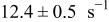 . The differential rate laws for various possible elementary steps have been integrated and the resulting expressions have been fit to experimental curves of voltage as a function of time. The results at lower temperatures are in agreement with a model in which response is limited by the rate of conversion of electron holes and singly charged oxygen anions to neutral oxygen atoms at the surface of the zirconia.
Access this article
The computer you are using is not registered by an institution with a subscription to this article. Please choose one of the options below.
Purchase from
Purchase this article from our trusted document delivery partners.

Make a recommendation
To gain access to this content, please complete the Recommendation Form and we will follow up with your librarian or Institution on your behalf.
For corporate researchers we can also follow up directly with your R&D manager, or the information management contact at your company. Institutional subscribers have access to the current volume, plus a 10-year back file (where available).
