
Abstract
The study of the different oxides of iron (II) and iron (III) was carried out potentiometrically in  eutectic at 470°C by means of an yttria‐stabilized zirconia electrode indicator of the oxide ion activity and an iron electrode indicator of the ferrous ion activity. These measurements were complemented by the determination of cyclic voltammograms and by x‐ray diffraction and infrared spectrophotometry analysis of certain compounds formed. The main results obtained are the following: strong oxidizing power (oxidation of Cl− ions into
 ) and high oxoacidity (great stability of ferric oxide) of Fe3+ ions; possible redissolution of
 in the oxide ion rich media by the formation of ferrate (III) ion;
 ions react with O2− ions to form ferrous oxide, which is probably stabilized in the form of a solid solution
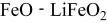 of composition
 . Magnetic oxide,
 , is stable and can be obtained by the action of oxide ions on a mixture of iron (II) and iron (III). The standard potentials of the different electrochemical systems, which involve iron in its different oxidation states, and the expressions of these potentials as a function of the oxide ion activity and different concentrations were given. The solubility products of iron oxides were also determined; the values corresponding to ferrous oxide, magnetic oxide, and ferric oxide are, respectively, 10−5.4, 10−36.3, and 10−29.6(molality scale). The constant of formation of ferrate (III) ion (from ferric oxide) has the rough value 101.9 mol · kg−1. These results were assembled in the form of a potential
 equilibrium diagram which shows, in particular, that in oxobasic media, magnetic oxide disproportionates into ferrate (III) and
 . In the presence of a high concentration of oxide anion,
 leads to the formation of metallic iron because of its disproportionation into
 and Fe (s).
Access this article
The computer you are using is not registered by an institution with a subscription to this article. Please choose one of the options below.
Purchase from
Purchase this article from our trusted document delivery partners.

Make a recommendation
To gain access to this content, please complete the Recommendation Form and we will follow up with your librarian or Institution on your behalf.
For corporate researchers we can also follow up directly with your R&D manager, or the information management contact at your company. Institutional subscribers have access to the current volume, plus a 10-year back file (where available).
