
Abstract
The oxidation of  to water on commercial platinum catalyzed carbon-polytetrafluoroethylene gas diffusion electrode (GDE) has been studied in deoxygenated aqueous solutions with KOH concentrations in the range
 . The
 couple behaves reversibly in open circuit, closely following the Nernst equation. A semiempirical equation in agreement with a Tafel–Volmer mechanism, accounting for diffusion, adsorption, inhibition, charge transfer, and ohmic-type drop in the wetted electrode pores, has been developed to quantitatively explain the steady-state linear sweep voltammograms for the different media, temperatures, and feeding hydrogen partial pressures tested. Charge transfer is also slow at high overpotentials except for
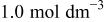 KOH. The micropolarization in the current–potential region around the reversible potential has been interpreted considering the Tafel reaction as the rate-determining step. The decay in exchange current density and the increase in activation energy both, at the reversible potential and high overpotentials, with raising KOH concentration has been ascribed to the increasing blocking and energetic effect of adsorbed hydroxyl species. The results of the activation energies suggest that the reactive Pt(110) faces are dominant in the dispersed Pt particles of the GDE.
Access this article
The computer you are using is not registered by an institution with a subscription to this article. Please choose one of the options below.
Purchase from
Purchase this article from our trusted document delivery partners.

Make a recommendation
To gain access to this content, please complete the Recommendation Form and we will follow up with your librarian or Institution on your behalf.
For corporate researchers we can also follow up directly with your R&D manager, or the information management contact at your company. Institutional subscribers have access to the current volume, plus a 10-year back file (where available).
