
Abstract
By using X‐ray diffraction lattice parameter measurements and Raman spectroscopy studies, both the solid solubility limit of titania in yttria tetragonal zirconia polycrystalline solid solutions  and the
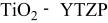 tetragonal solid solution field in the
 system have been established. Valence state, site symmetry, and changes in local structures of Ti ions in Y‐TZP with 5 and 10 mol %
 are studied for the first time using EXAFS (extended X‐ray absorption fine structure), XANES (X‐ray absorption near edge structure), and X‐ray photoelectron spectroscopy. The total electrical conductivity in air of the
 tetragonal solid solution decreases with increasing titania content. XANES results show that as the
 dissolves into the tetragonal zirconia Y‐TZP matrix, a displacement of
 ions from the center of symmetry seem to take place which leads to a nonrandom substitution of
 ions on
 lattice sites. Ti‐O bond distances derived from EXAFS results indicate that
 ion can be in a square‐pyramidal arrangement, i.e., fivefold oxygen‐coordinated. As a consequence, two kind of cation‐oxygen vacancy associations (
 and
 ) with different diffusion dynamics are created. This results in a decrease of the global concentration of moving oxygen vacancies and therefore, a decrease of ionic conductivity. Electronic conductivity, n‐type, only appeared at oxygen partial pressure lower than
 atm and above 800°C in Y‐TZP containing 10 mol % titania. Such an n‐type electronic conduction was attributed to a hopping of electrons between
 and
 cations by a small polaron hopping mechanism. © 1999 The Electrochemical Society. All rights reserved.
Access this article
The computer you are using is not registered by an institution with a subscription to this article. Please choose one of the options below.
Purchase from
Purchase this article from our trusted document delivery partners.

Make a recommendation
To gain access to this content, please complete the Recommendation Form and we will follow up with your librarian or Institution on your behalf.
For corporate researchers we can also follow up directly with your R&D manager, or the information management contact at your company. Institutional subscribers have access to the current volume, plus a 10-year back file (where available).
