
Abstract
The concept of an all solid state leakage free electrochemical double layer capacitor is presented. It combines two activated carbon electrodes assembled with an ionogel solid state electrolytic separator. This ionogel is a chemical gel, which consists of a room temperature ionic liquid, 1-Ethyl-3-Methyl Imidazolium Bis(trifluoromethanesulfonylimide) confined within a continuous monolithic silica host network, preventing any leakage of the electrolyte meanwhile preserving its liquid physical properties. The ionogel based EDLC can be operated up to 3 V with a device capacitance of 20 F.g−1 (80 F.g−1 per electrode) and exhibits no noticeable fade in capacitance after 10,000 cycles.

This is an open access article distributed under the terms of the Creative Commons Attribution Non-Commercial No Derivatives 4.0 License (CC BY-NC-ND, http://creativecommons.org/licenses/by-nc-nd/4.0/), which permits non-commercial reuse, distribution, and reproduction in any medium, provided the original work is not changed in any way and is properly cited. For permission for commercial reuse, please email: oa@electrochem.org.
Nowadays electrochemical double layer capacitors (EDLCs, so-called supercapacitor) are mostly using acetonitrile based electrolytes. This solvent is detrimental to the safety of the devices due to its low boiling point (81.6°C), high vapor pressure at room temperature (9.7 kPa at 20°C) and high flammability (flash point = 12.8°C). Many studies aim at replacing acetonitrile by other solvents such as adiponitrile1 or different carbonates.2–4 Ionic liquids (ILs) are now envisioned as possible electrolyte for EDLCs.5–7 However, the use of ionic liquids does not solve the problems related to possible leakage. Thus, the development of all solid state EDLC is an important issue to improve the safety of energy storage and facilitate their use. Furthermore micro EDLCs (micro-supercapacitors) have also attracted much attention in the last five years but there is still a need for a solid state electrolyte with fair ionic conductivity and no leakage risk. Several studies were conducted toward this direction. For instance, silica particles were tested as fillers in polyethylene oxide (PEO) - ionic liquid membranes for supercapacitors applications.8 Many other examples of association of organic polymers with ILs have been presented in the literature,9,10 but remain limited by the thermal degradation of the polymer. Getting rid of the polymer, the use of a physical gel consisting of a mixture of silica nanoparticles and ionic liquid, as presented ten years ago,11 has also been proposed on interdigitated graphene devices.12 The use of this electrolyte shows a larger electrochemical window (2.5 V) compared to PolyVinyl Acetate gels (1 V).12 However, such physical, not self-standing gel requires to be sealed in a rigid container to avoid any leakage and to prevent from creeping. Additionally, the amount of ionic liquid present in such physical gel is limited by the need to have enough silica particles to assume a mechanically stable architecture. Subsequently, self-standing robust solid electrolyte, allowing easy shaping, with a high amount (∼82%vol.) of ionic liquid, and showing liquid-like physical behavior are the main reasons leading to the use of chemical ionogels.
Such ionogel electrolytes were already reported,13,14 and successfully applied to all-solid state lithium battery in which the solid ionogel plays the role of both electrolyte and separator,15,16 endowed with liquid dynamics properties. Other studies were carried out more recently on similar ionogels, but with different composition which resulted in very poor mechanical properties (Young modulus 103 times lower), prohibiting their use as self standing electrolytic separator in all solid state devices without crushing.17
Here, we demonstrate the feasibility to design a symmetric supercapacitor with the use of an 1-Ethyl-3-Methyl Imidazolium (EMIm) Bis(trifluoromethanesulfonylimide) (abbreviated most often in the literature TFSI, or also TFSA and NTf2−) based chemical ionogel with a very good, given the solid state, ionic conductivity at room temperature (∼1.5 mS.cm−1). EMImTFSI has a wide temperature stability window i.e. a broad temperature operating range (melting point −16°C, degradation temperature 417°C).18 Moreover, a secure non flammability is obtained, contrary to typical organic electrolytes. Since a high amount of ionic liquid is confined within an inert mesoporous silica matrix preventing its leakage and providing easy shaping, a mechanically solid-like electrolyte with liquid-like transport properties was obtained. It is also worth to point out that confining IL within such mesoporous silica host network allows to retain liquid-like dynamics at temperatures as low as −20°C as shown in previous work.13 This solid electrolyte is synthesized and casted onto activated carbon electrodes using a one step process. The performance of an all-solid state symmetrical carbon based EDLC using ionogel as electrolyte and separator is described herein.
Materials and Methods
Carbon electrodes fabrication
Carbon electrodes were prepared by assembly of activated carbon as the capacitive material (NORIT S50, 80 wt%), carbon black as a conductive additive (super P, 10 wt%) and a polymer binder (PVDF-HFP, 10 wt%) in order to keep the mechanical integrity of the electrodes. The PVDF-HFP was in suspension in N-methyl-2-pyrrolidone at 6 wt%. The mixture is blended under magnetic stirring during several hours. The obtained black paste is then casted on 1 cm2 aluminum current collectors with a mass loading of ∼1 mg.cm−2, determined by weighting the aluminum current collector before and after carbon casting (± 20 μg accuracy).
Ionogels synthesis
Ionogels are obtained from a sol made of tetramethoxysilane (TMOS ≥ 99%, Fulka) solubilised in an ionic liquid (EMImTFSI 99.9%, Solvionic); formic acid (FA, ≥ 98%, Sigma Aldrich) is used to trigger the sol gel reaction resulting in the ionogel, monolithic chemical gel, made of mesoporous silica confining the IL initially used for the precursors solubilization. To obtain a solid ionogel, the molar ratio IL/Si must be below ∼1.19 On one hand, the ratio has to be maximized since the conductivity increases with IL content, but on the other hand the mechanical properties decrease when silica relative content is minimized. In our case, a molar ratio IL/Si of 0.5 has been used, leading to a trade-off between a fair ionic conductivity (∼1.5 mS.cm−1 at 20°C) and good mechanical properties. The amount of FA must be considered too since it triggers the sol gel reaction. Previously, the molar ratio FA/TMOS was chosen between 6 and 7.820 but a complete reaction of TMOS within an acceptable period of time was achieved with a ratio of 4.21 Decreasing this ratio is convenient in order to reduce the shrinkage of the ionogel during aging since there is a lower volume of FA that must be evaporated during completion of the reaction.
Ionogel casting
TMOS is mixed with EMImTFSI during 10 minutes. Then FA is added and the sol is stirred during 10 more minutes. It is then casted on the carbon electrodes using 200 μm thick PTFE molds. Concomitantly, a thick self-standing ionogel is prepared keeping the same experimental conditions for ionic conductivity measurements. This thick ionogel is left for aging 5 days at ambient temperature. The gelling time is around 30 to 40 minutes depending on the temperature and leads to a fast stabilization of the mass loss. The casted electrodes are left apart from each other at room temperature for 24 hours. They are then unmolded and the two electrodes are assembled without any separator using a stainless steel clamp to form a symmetrical supercapacitor (Fig. 1E). At this stage of the process, condensation is not completed and still occurs between the two casted electrodes to form a monolithic ionogel network acting both as separator and solid electrolyte. After an additional 24 hours, the cell is dried overnight by heating under vacuum (60°C, 0.5 mbar). For comparison purpose, symmetrical EDLC cells made with the same carbon electrodes (prior to ionogel casting) are assembled with EMImTFSI impregnated on a glass microfiber paper (Whatman GF/D). The ionogel wetting of the porous activated carbon electrode was observed using a scanning electron microscope MERLIN (Carl Zeiss) with a 3 kV accelerating voltage. The electrode was separated from the aluminum substrate during the cutting to obtain a cross section picture.
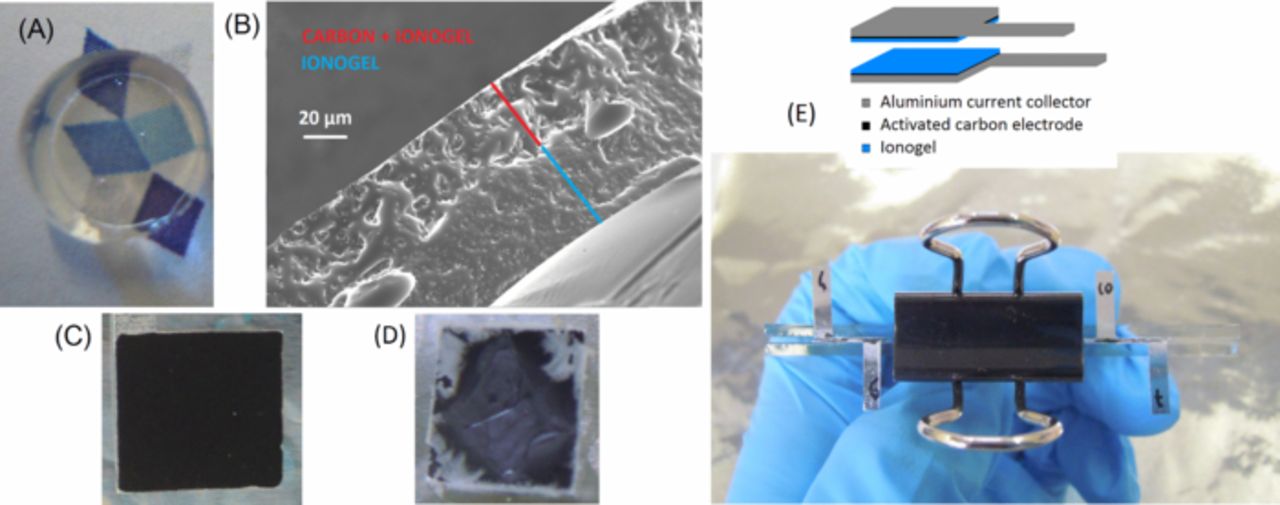
Figure 1. (A) Thick ionogel (x = 0.5, diameter = 0.9 cm, thickness = 3 mm) after 2 weeks; (B) SEM cross section of electrode with ionogel coating, (C) carbon electrode before and (D) after ionogel casting; (E) Solid state ionogel EDLCs.
Ionogel conductivity
After aging, the thick ionogel is polished to obtain two planar parallel faces. It is then dried overnight (60°C, 0.5 mbar residual pressure) to assure a water content below 50 ppm, and introduced in an argon filled glove box. In the glove box, the ionogel is placed in a Swagelok cell between two stainless steel electrodes. The measurement of the ionic conductivity of the ionic liquid requires the use of an additional Teflon ring. The conductivity is determined with electrochemical impedance spectroscopy (EIS) using 50 mV amplitude within a 200 kHz–35 Hz frequency range. The resistance value, taken at high frequency, enables the calculation of the ionogel ionic conductivity according to equation 1:

Where σ is the ionic conductivity (S.cm−1), e is the ionogel thickness (cm), R is the resistance value obtained with the EIS spectra (Ω) and S is the surface of the ionogel (cm2).
EDLC electrochemical characterization
Electrochemical measurements are performed in an argon filled glove box at room temperature (∼20–25°C) with a multi-channel potentiostat (VMP3 from BioLogic). Cyclic voltammograms are measured between 0 and 3 V using different scan rates. The cell capacitance is calculated by integrating either the oxidative or the reductive part of the cyclic voltammogram over the potential window of the CV, and dividing by the total mass of both electrodes (gravimetric cell capacitance) or by the cell area (capacitance per unit area). To obtain the gravimetric capacitance of a single carbon electrode, the gravimetric cell capacitance is multiplied by a factor of 4. Constant current charge/discharge galvanostatic cycles are performed at 1 mA.cm−2 (∼ 1 A.g−1).
Results and Discussion
Ionogels morphology
After aging, the solid ionogels can be easily handled, without crushing when assembled either for conductivity measurements or for supercapacitors assembly. They are transparent without any noticeable color (Fig. 1A). The thick ionogel does not show any leakage. Under cross-sectional SEM observation (Fig. 1B), the ionogel film shows a good wetting of the carbon electrode. Fig. 1C and 1D depict the influence of the ionogel casting on the morphology of carbon electrodes. During aging and shrinkage of the ionogel, no contact loss between carbon and aluminum was noticed. Nevertheless, some cracks perpendicular to the surface are present and white parts of ionogel can be observed on the edge of the electrode corresponding to a larger concentration of holes in the ionogel as observed by scanning electron microscopy. However, they are not detrimental to the electrochemical performance as demonstrated later on.
Ionic conductivity of ionogels
As presented Fig. 2, the ionic conductivity of pristine EMImTFSI is 8.5 mS.cm−1 at 20°C, which is close to the expected value (8.8 mS.cm−1 at 27°C).22 The ionogel conductivity (1.5 mS.cm−1, 20°C) is lower than that of pristine IL; nevertheless it is worth to point out that the calculation refers together to IL and its silica host matrix. This value is rather high for a solid state electrolyte and enables to validate the concept of all solid state leakage free supercapacitor. However, the thickness of the ionogel electrolyte has to be optimized to fulfill the requirements for low temperature applications.
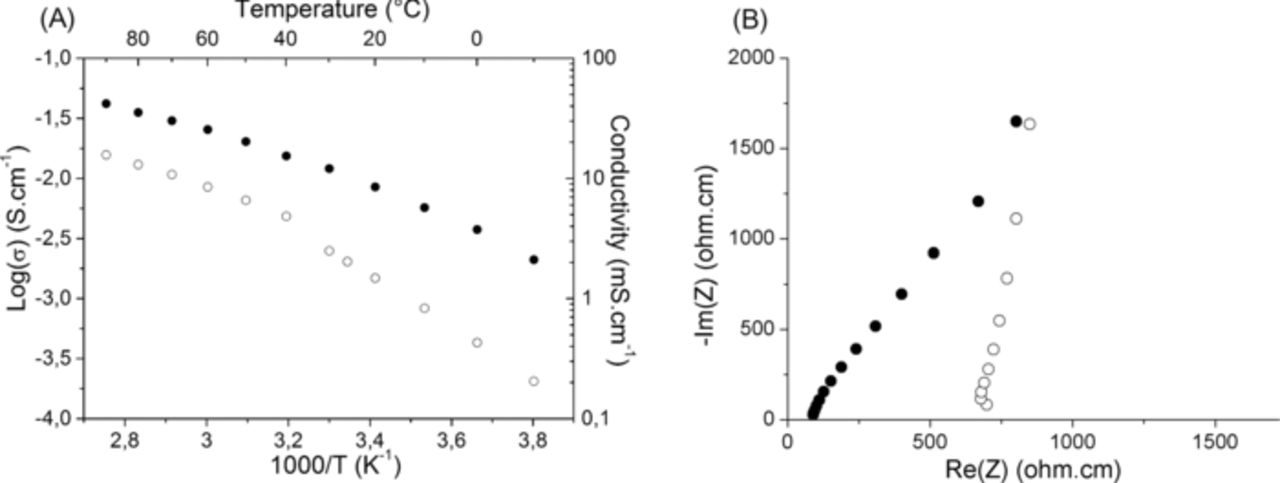
Figure 2. (A) Arrhenius plot of an ionogel (○) conductivity and comparison with the corresponding ionic liquid (●). (B) EIS plots of ionic liquid (●) and ionogel (○) at 20°C.
EDLC characterization
The cyclic voltammograms of pristine IL and ionogel EDLC (Fig. 3A) are symmetrical and show quasi-rectangular shapes. At low scan rate (2 mV.s−1) the two EDLC devices show exactly the same behavior with a cell capacitance of 38 and 39 mF.cm−2 resp. (18 and 20 F.g−1 resp.). These values correspond to 72 and 80 F.g−1 for activated carbon electrodes. The all solid state device exhibits a more resistive behavior when scan rate increases due to the lower conductivity of the ionogel compared to that of the ionic liquid soaked separator.
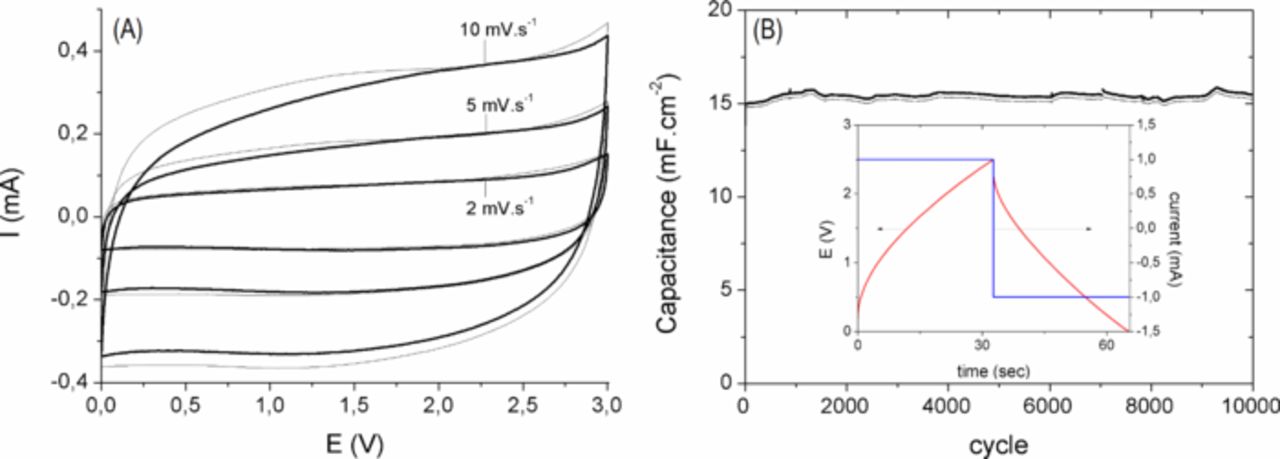
Figure 3. (A) Cyclic voltammetry (0 to 3 V) at different scan rates (2, 5 and 10 mV.s−1) with ionogel (―) and EMImTFSI (―) electrolytes.(B) Long term cycling behavior of EDLC with Ionogel electrolyte : charge(▬) and discharge (―) capacitances obtained with GCPL I = 1 mA.cm−2(∼1 A.g−1). The insert shows the detail of a charge/discharge cycle.
It can be noticed that for both devices an increase in the current density appears above 2.5 V. This could be assigned to a degradation of the electrolyte, or of the carbon electrode or the aluminum current collector. Indeed, the coulombic efficiency upon cycling is better when the cell voltage is limited to 2.5 V: 98% vs. 96% when a 3.0 V maximum cell voltage is used. Thus, an upper cutoff cell voltage of 2.5 V was chosen to perform galvanostatic cycling tests. This maximum cell voltage is similar to that used in EDLC devices with volatile organic electrolytes.23
Galvanostatic cycling (Fig. 3B) has been performed on the ionogel based EDLC. With a 1 mA.cm−2 constant charge discharge current (1 A.g−1) a cycle is completed within 60 seconds (see insert in Fig. 3B). The all solid state cell exhibits a stable capacitance over more than 10,000 cycles between 0 and 2.5 V. The coulombic efficiency remains over 98% during the cycling. Small variations in the capacitance during cycling are due to room temperature fluctuation. In the glove box, the ionogel EDLC was not sealed in a container but did not show any electrolyte leakage during the whole experiment. Clearly, it did not dry over the 10,000 cycling time. The limited value of cell capacitance (15.5 mF.cm−2) is due to the high scan rate used for long-term cycling experiments.
Conclusions
This paper presents the concept of all solid state supercapacitors with symmetrical activated carbon electrodes using ionic liquids confined within a chemical gel made of mesoporous silica. The chemical ionogel acts simultaneously as electrolyte and as separator. The electrochemical stability window of the all solid devices has been determined between 0 and 2.5 V. This device shows very good cyclability (>10.000 cycles) and efficiency (>98%). Further improvements will aim at optimizing carbon electrode formulation and at investigating thermal stability of the solid state device, as well as investigating low temperature operation.
Acknowledgments
The authors would like to thanks Solvionics for providing ionic liquids. French National Research Agency is also greatly acknowledged for supporting this project (ISICAP) within the framework of the ANR Blanc Call for proposal.