

Abstract
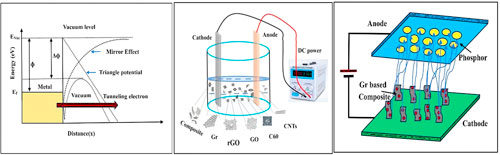
Benefits from unique properties, graphene electron field emission is critical for vacuum nanoelectronics. Electrophoretic deposition (EPD) is pivotal for graphene emitters, offering cost-effectiveness, scalability, and morphology control. The review highlights the role of EPD in fabricating graphene and graphene based composite emitters for electron emission. Through substrate engineering and process optimization, EPD graphene produces vertically aligned edges and porous structures, maximizing field enhancement factors (β) and emission sites. The ultra-low turn-on fields, high β values and stable current density can be obtained. Graphene-based composites amplify field emission performance through synergistic effects, which can enhance local field concentration, reduce contact resistance, modulate work functions and facilitate charge transfer via heterojunction band bending. The relevant theories support the experimental results. EPD bridges lab and industry, with challenges in uniformity and stability. Future work focuses on atomic engineering and machine learning, positioning EPD-graphene systems to redefine next-gen electronics.
Download figure:
Access this article
The computer you are using is not registered by an institution with a subscription to this article. Please choose one of the options below.
Purchase from
Purchase this article from our trusted document delivery partners.

Make a recommendation
To gain access to this content, please complete the Recommendation Form and we will follow up with your librarian or Institution on your behalf.
For corporate researchers we can also follow up directly with your R&D manager, or the information management contact at your company. Institutional subscribers have access to the current volume, plus a 10-year back file (where available).
