
Abstract
The theoretical energy densities of dual-electrolytes rechargeable Li-air batteries using a nonaqueous electrolyte in the anode and an aqueous electrolyte in the cathode are estimated based on the electrochemical reaction mechanisms and the solubility of the discharge product. It is assumed that there is no solid deposition in a cathode during discharge. A number of basic and acidic electrolytes with high solubility of the discharge product are proposed. The theoretical energy densities of these rechargeable Li-air batteries vary from 140 to over  depending on the type of the electrolytes in a cathode. A few structures of Li-air flow battery systems for possible large scale applications are also proposed.
Recently, Li-air batteries have attracted much attention due to their relatively low cost and extremely high specific capacity.1–5 In a conventional nonaqueous Li-air battery, the Li anode is electrochemically coupled to atmospheric oxygen  through an air cathode. During discharge, Li ions flow from the anode through an electrolyte and react with
 at the cathode to form
 or
 . The reason for the high specific capacity is that the lithium anode electrode is usually light and the cathodic reactant
 is taken from the air. The theoretical maximum capacity of Li-air batteries is determined assuming complete electrochemical oxidation of the metallic Li anode. The theoretical specific capacity of Li is
 ,6 which is much higher than that of any other type of electrode materials used in advanced Li-ion or Li-polymer batteries. Considering an operational voltage of
 , the theoretical maximum energy densities of Li-air batteries have been calculated based on charge balance and are in the range
 , depending on the type of the electrolytes used;7 these values are not only much higher than those of any advanced batteries but also higher than that of fuel cells.
Although Li-air batteries have an extremely large theoretical energy density, they suffer from several severe drawbacks: (1) The 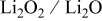 discharge product in nonaqueous electrolytes and the
 product in aqueous electrolytes deposit on the air side of the electrode reducing the pore size and limiting the access of
 in the cathode.3 The discharge products deposit mostly near the air side of the electrode because the
 concentration is higher on this side.2, 4, 8 This inhomogeneous deposition of the reaction products really limits the usage of cathode volume, which limits the maximum capacity and the energy density of the battery; (2) the cyclability and energy efficiency of Li-air batteries are poor due to the lack of effective catalysts to convert the solid
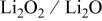 or
 discharge products into Li ions;9 and (3) the current and power densities of Li-air batteries are much lower compared to those of conventional batteries.
Recently, the concept of rechargeable Li-air batteries was proposed and demonstrated by Wang and Zhou10 and Zhang et al.11 These rechargeable Li-air batteries have an aqueous electrolyte in the cathode and produce a water soluble discharge product. The charging process is achieved through an oxygen evolution process. The rechargeable Li-air batteries can be divided into two categories depending on the basic or acidic nature of the electrolytes used in cathode electrodes.
Rechargeable Li-Air Batteries Using Basic Electrolyte
In the rechargeable Li-air battery shown in Fig. 1, the Li metal is used as an anode due to its high specific capacity and low potential, while the porous carbon is used as the air electrode. However, the proposed Li-air batteries are using a nonaqueous electrolyte in the anode and an aqueous electrolyte such as diluted LiOH solution in the cathode electrodes. A solid Li-ion conductive membrane (such as Li-ion conducting glass-ceramic, LIC-GC) is used between the anode and the air electrodes. The LIC-GC membrane plays an important role in Li-air flow batteries. This membrane does not only have a good conductivity for Li ions but also good chemical stability in both nonaqueous and diluted LiOH solutions, as well as be able to isolate the two electrolytes. The overall reaction for Li-air flow battery can be expressed as

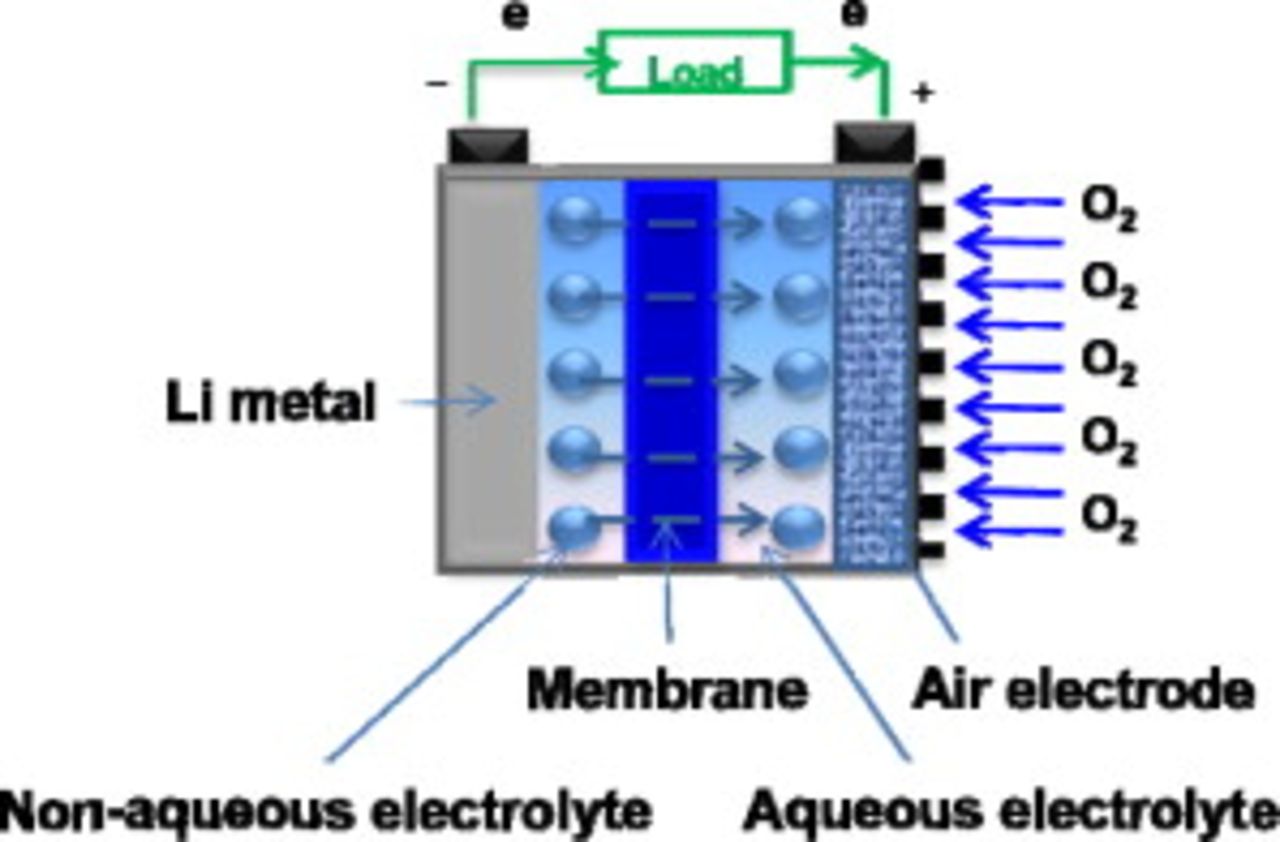
Figure 1. Diagram showing the operational principle of a rechargeable Li-air battery using dual electrolytes.
The LiOH discharge product is formed at the surface of the carbon through a charge exchange process and, then dissolved in water. The maximum concentration of  and
 ions is determined by the solubility of LiOH in water, which is
 of
 of water
 at
 .12 When the
 and
 concentrations reach this value, LiOH will precipitate, thus filling up the porous volume in the air electrode and eventually blocking the
 channels and stopping the discharge process. To prevent this solid deposition, additional
 is introduced. Considering the solubility of LiOH in
 ,
 LiOH needs at least
 mol of


where  and
 are the molecular weights of LiOH and
 , respectively. Therefore, the overall mass balance can be expressed as

The specific capacity excluding  can be computed as

The operational voltage is assumed to be  ; therefore, the estimated energy density of the system (excluding
 ) is

The weight ratio of active materials of Li and  can be determined by
 Li vs

 as shown in Eq. 4 and is
 in the battery. The weight of
 dominates in the total weight of the battery. The above energy density is calculated based on only the Li metal and the electrolytes
 , and is much lower than the theoretical limitation of conventional Li-air batteries with solid discharge products for using either nonaqueous or dual electrolytes.7 Considering the other necessary materials such as carbon in the cathode electrode, current collectors, electrolyte membrane, and packaging, the energy density of rechargeable Li-air batteries would not be much greater or perhaps slightly less than that of advantage Li-ion batteries. The power density of Li-air batteries is comparable to the one of Li-air batteries and is expected to be much lower than that of Li-ion batteries since it is determined by the
 solubility and diffusivity in the electrolyte.From Eq. 1, the
 evolution is involved during the charge process. In order to maximize the energy efficiency of Li-air batteries, it might be efficient to distribute an electrocatalyst in the air electrode in order to reduce the
 evolution potential. The specific capacity and energy density calculated based on Eq. 4, 5 excluded
 from air. The specific capacity and energy density including
 will be slightly lower due to the total weight increasing during the discharge process, which was discussed previously.7
Rechargeable Li-Air Batteries Using Acidic Electrolyte
From Eq. 1, it can be seen that the discharge process consumes  . Unlike in batteries with basic electrolyte, the discharge process in batteries with acidic electrolyte does not consume the water but they produce water as a result of the reaction in the cathode electrode. The overall electrochemical reaction in batteries with acetic acid
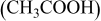 solution as the electrolyte can be expressed as follows11

The solubility of the  discharge product in
 is

 in

 . Each mole of
 needs at least
 of
 in order to avoid solid deposition in the cathode. Therefore, the specific capacity of the battery excluding
 can be calculated as

where  is the molar mass of
 . The maximum energy density is

This value is close to that obtained for batteries using a basic electrolyte, but is less than that estimated by Zhang et al.11 The mass ratio of active materials of Li,  , and
 can be determined by



 as shown in Eq. 7 and is
 . The weight of
 still dominates in the total weight of the battery. The theoretical energy density for Li-air batteries using different acidic electrolytes can also be estimated using a procedure similar to the one presented in the previous section. Table I lists some possible Li-air batteries using different electrolytes in cathode. The overall chemical reactions during the charge/discharge and solubility of discharge products, are all included in the table. The minimum amount of
 needed for dissolving
 of Li discharge product, the specific capacity, and the maximum energy density are calculated based on Eq. 6, 7, 8 and are listed in Table II. From Table II, it can be seen that the electrolyte in the cathode including salt and
 dominates the weight of the battery and, in general, the higher the solubility of the discharge product the higher the energy density of the battery is.
Table I. Summary of Li-air batteries using different electrolytes in cathode and the solubility of discharge products.
| Salt in electrolyte | Molar mass (g/mol) | Overall reaction equation | Discharge product | Solubility
| Molar mass of product (g/mol) |
|---|---|---|---|---|---|
| Diluted LiOH | 23.95 |

| LiOH | 12.5 | 23.95 |
Acetic acid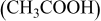
| 60.05 |

|

| 45 | 65.99 |
Chloric Acid
| 84.46 |

|

| 459 | 90.40 |
Perchloric acid
| 100.46 |

|

| 58.7 | 106.40 |
| Formic acid (HCOOH) | 46.03 |

| HCOOLi | 39.3 | 51.97 |
Nitric acid
| 63.01 |

|

| 102 | 68.95 |
Salicylic acid
| 138.12 |

|

| 133.3 | 144.06 |
Sulfuric acid
| 98.08 |

|

| 34.2 | 109.96 |
| Hydrobromic acid (HBr) | 80.91 |

| LiBr | 181 | 86.85 |
| Hydrochloric acid (HCl) | 36.46 |

| LiCl | 84.5 | 42.40 |
| Thiocyanic acid (HSCN) | 59.09 |

| LiSCN | 120 | 65.03 |
Table II. Summary of specific capacities and energy densities for Li-air batteries using different electrolytes, and weight ratios of active materials in batteries.
| Salt in electrolyte | Minimum amount  for  of product (mol) | Additional  for 1 mol of product (mol) | Specific capacity (mAh/g) | Energy density at  (Wh/kg) | Mass ratio (Li/Salt/Water) |
|---|---|---|---|---|---|
| Diluted LiOH | 11.14 | 11.14 | 129.19 | 476.70 | 3.35/0/96.65 |
Acetic acid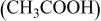
| 8.15 | 7.65 | 130.97 | 483.28 | 3.39/29.35/67.26 |
Chloric Acid
| 1.09 | 0.59 | 262.51 | 968.68 | 6.80/82.73/10.47 |
Perchloric acid
| 10.07 | 9.57 | 95.83 | 353.63 | 2.48/35.92/61.60 |
| Formic acid (HCOOH) | 7.35 | 6.85 | 152.10 | 561.24 | 3.94/26.12/69.94 |
Nitric acid
| 3.76 | 3.26 | 208.49 | 769.33 | 5.40/49.02/45.58 |
Salicylic acid
| 6.00 | 5.50 | 109.78 | 405.10 | 2.84/56.58/40.58 |
Sulfuric acid
| 17.86 | 17.36 | 72.73 | 268.37 | 1.88/13.31/84.81 |
| Hydrobromic acid (HBr) | 2.67 | 2.17 | 211.31 | 779.74 | 5.47/63.79/30.74 |
| Hydrochloric acid (HCl) | 2.79 | 2.29 | 316.88 | 1169.29 | 8.20/43.11/48.69 |
| Thiocyanic acid (HSCN) | 3.01 | 2.51 | 240.97 | 889.19 | 6.24/53.13/40.63 |
It should be pointed out that a number of different electrolytes are listed in Tables I and II as the potential candidates to be used in dual-electrolytes rechargeable Li-air batteries; however, so far only two electrolytes, such as LiOH and  solutions, have been demonstrated experimentally.10, 11 From Table II, it can also be seen that the highest energy density can be achieved by using strong acid solutions such as HCl and
 solutions due to the high solubility of discharge products. However, some practical problems must be solved for using strong acid solutions such as stability of the electrode and catalyst materials, current collectors, and membrane.
In addition to the Li metal anode electrode, another important electrode in Li-air batteries is electrical conductive air electrode (cathode). The optimal thickness of the cathode electrode is determined by the oxygen diffusion length, which can be expressed as13
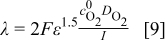
where ε is the porosity of the cathode electrode,  is the oxygen concentration in the electrolyte near the air side,
 is the effective diffusion constant of the oxygen, and
 is the discharge current density. For instance, for a battery operating at a discharge current of
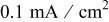 , initial cathode porosity of 75%, external pressure of the atmosphere of
 air, and
 diffusion coefficient of
 , the cathode thickness in Li-air batteries should be of the order of
 . It can be easily estimated that when the cross-sectional areas of both the anode and the cathode are the same, the thickness ratio for the cathode and the anode will be as large as 15:1 in order to fully utilize the Li in batteries using either diluted LiOH solution or
 electrolytes. Therefore, the volume of the cathode will be much greater than that of the anode. In addition to the electrolyte, other necessary materials including porous electrical conductive materials (such as high surface carbon), catalysts, current collectors, and hydrophobic filters are needed.
Li-Air Flow Batteries
The structure of Li-air batteries can be adjusted to be similar to the structure of fuel cells in which the electrochemical reactor and the fuel (electrolyte) storage are two separate units. In Fig. 2 we propose a Li-air flow battery system consisting of two units: the electrochemical reaction unit and the electrolyte reservoir. Similar to Li-air batteries, the Li metal from the electrochemical reaction unit is used as an anode due to its high specific capacity and low potential, while the porous carbon will be used as the air electrode. A solid Li-ion conductive membrane is used between the anode and the air electrodes. From Fig. 2, the proposed Li-air flow batteries are different from Li-ion, Li-air, and other conventional rechargeable batteries in which the maximum energy storage and power deliverable capability are proportional to the weight of the battery; the proposed Li-air flow battery is more like a fuel cell, in that the energy and power capabilities can be totally separated according to the load requirements. In Li-air flow batteries, the total energy storage is mainly determined by the volume of the Li-ion reservoir (or electrolyte container) and the maximum power capability is determined by the size and electrode configuration of the electrochemical reactor. A minimum amount of Li anode material in the battery can be determined by the weight ratio of active materials as discussed before. Other factors such as conductance of membrane,  solubility, and diffusivity can also affect the power capability of Li-air flow batteries. The proposed Li-air flow battery is different from a previously proposed rechargeable Li-air battery,10 which is based on a hypothesis that Li metal can be regenerated from LiOH discharge product; however, the method for regenerating Li method was not mentioned in the paper.
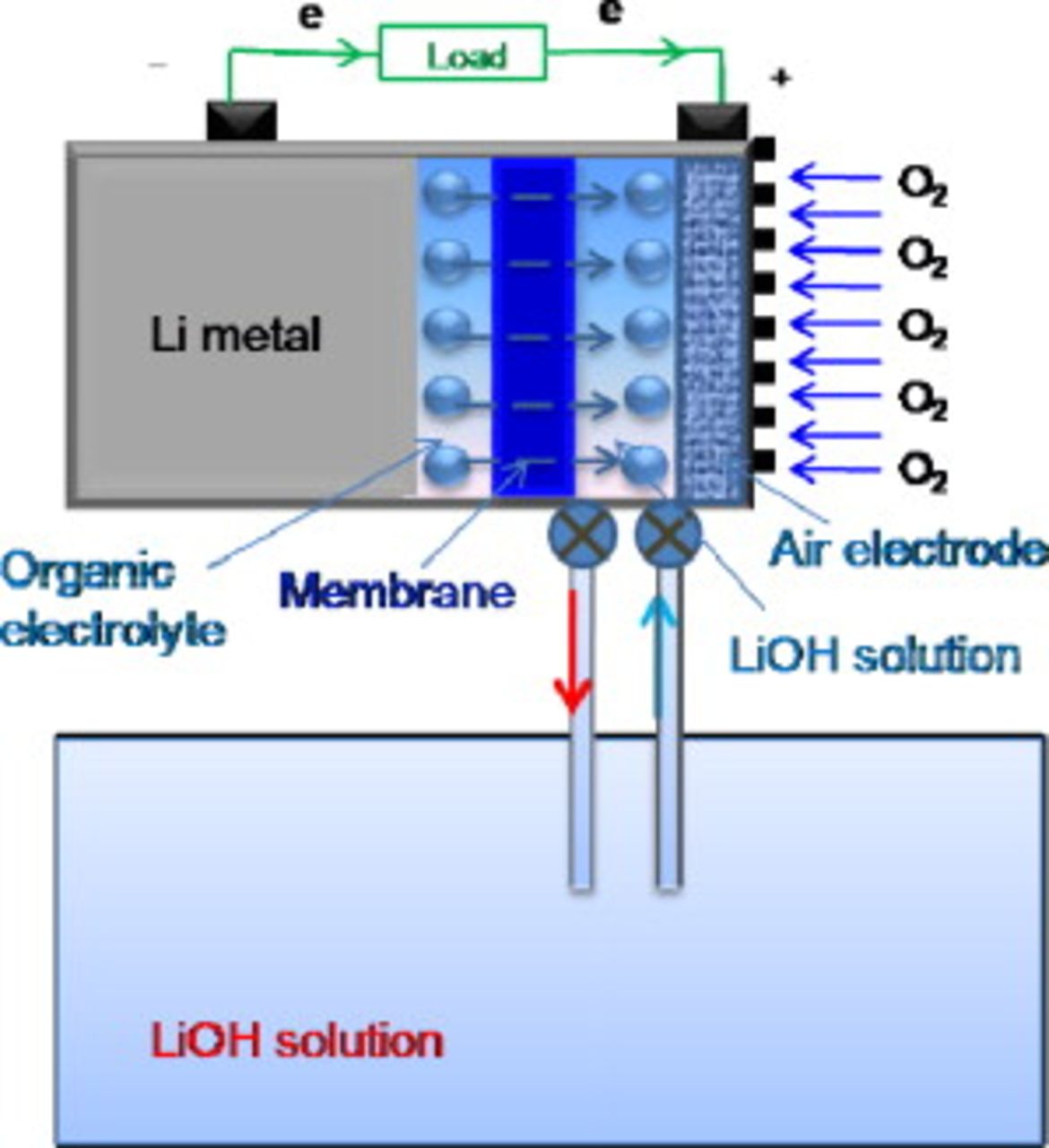
Figure 2. Diagram showing the operational principle of a Li-air flow battery.
It should be pointed out that the cost of Li-air flow batteries could be significantly lower than that of Li-ion batteries if the cost of the membrane can be reduced. In addition, the manufacture shipment costs and installation weight of Li-air flow batteries are low, because only the Li metal and the thin cathode which is less than 10% of the total weight of the battery electrode need to be pre-installed. The major weight of the battery is the weight of the electrolyte (e.g., using  in basic electrolyte), which can be easily obtained and introduced in the battery after it is installed on site. Since the thickness of the cathode electrode in the Li-air battery can be as short as the oxygen diffusion length, the Li-air flow battery can effectively reduce the thickness of the cathode electrode; therefore, reduce the cell resistance due to shortening the Li ion path distance in a cathode. Therefore, the advantages of Li-air flow batteries include low cost, high energy density, good cyclability, low losses, and easy-scale-up compared with other electric energy storage batteries used in grid scale applications.
The theoretical energy density of Li-air flow batteries is the same as that of rechargeable Li-air batteries as discussed above, and is determined by the electrochemical reaction equation (e.g., Eq. 1, 6) and solubility of the discharge product; however, the discharge power density of these batteries is mainly determined by the oxygen solubility and diffusivity according to our previous work in which a physics-based model is developed for the simulation of Li-air batteries.13 The model has been carefully calibrated against published data and is used to simulate Li-air batteries with nonaqueous (organic) electrolyte.
It should be pointed out that one key technical issue of making Li-air or Li-air flow batteries is the quality of the Li-ion conductive membrane. The researches should emphasize the water permeability and stability of the membrane in both aqueous and nonaqueous electrolytes. Other properties of the membrane such as the mechanical properties, the scalability, and the calendar life of membrane are also important.
Conclusion
The theoretical energy densities of rechargeable Li-air batteries with no solid deposition during charge/discharge are estimated according to the mass balance equation, and are  which is lower than
 for primary Li-air batteries with a solid discharge product. These values are obtained based on the weight of only active materials, however, other materials such as current collectors, membrane, and package materials should also be considered for a practical battery. The main difference between rechargeable Li-air batteries and primary Li-air batteries is that no solid discharge products deposit in the air electrode in rechargeable Li-air batteries. In this paper, possible Li-air flow battery configurations are proposed. The most important difference between Li-air flow batteries and Li-air batteries is that the Li-air flow batteries separate the maximum energy storage and power capabilities. The energy and power densities are mainly determined by the volume of the electrolyte reservoir and the electrochemical reactor, respectively. Li-air flow batteries could be particularly suitable for a large scale application such as electric grid energy storage.
Acknowledgments
The work was supported by National Sciences Foundation under Engineering Research Center Program no. EEC-0812121 and U.S. Army CERDEC.
Florida A&M University and Florida State University assisted in meeting the publication costs of this article.
