

ABSTRACT
Turbulence driven by magnetorotational instability (MRI) affects planetesimal formation by inducing diffusion and collisional fragmentation of dust particles. We examine conditions preferred for planetesimal formation in MRI-inactive “dead zones” using an analytic dead-zone model based on our recent resistive MHD simulations. We argue that successful planetesimal formation requires not only a sufficiently large dead zone (which can be produced by tiny dust grains) but also a sufficiently small net vertical magnetic flux (NVF). Although often ignored, the latter condition is indeed important since the NVF strength determines the saturation level of turbulence in MRI-active layers. We show that direct collisional formation of icy planetesimal across the fragmentation barrier is possible when the NVF strength is lower than 10 mG (for the minimum-mass solar nebula model). Formation of rocky planetesimals via the secular gravitational instability is also possible within a similar range of the NVF strength. Our results indicate that the fate of planet formation largely depends on how the NVF is radially transported in the initial disk formation and subsequent disk accretion processes.
1. INTRODUCTION
Formation of kilometer-sized planetesimals is the initial step of planet formation in protoplanetary disks. Several mechanisms have been proposed for planetesimal formation, which include gravitational instability (GI) of dust subdisks (e.g., Goldreich & Ward 1973; Johansen et al. 2007; Youdin 2011) and direct coagulation (e.g., Weidenschilling & Cuzzi 1993; Okuzumi et al. 2012). However, the outcome of these processes strongly depends on the turbulent state of the gas disk. Turbulence is known to concentrate particles of particular sizes, which could assist their gravitational collapse (Cuzzi et al. 2001; Johansen et al. 2007). On the other hand, turbulence also stirs up dust subdisks and thereby stabilizes GI (Turner et al. 2010). In addition, the relative velocity induced by turbulence can lead to catastrophic disruption of large dust particles (Johansen et al. 2008).
The magnetorotational instability (MRI; Balbus & Hawley 1991) has been thought to be the most plausible driving mechanism of protoplanetary disk turbulence. The activity of MRI largely depends on non-ideal MHD effects (e.g., Sano & Miyama 1999; Bai & Stone 2011; Wardle & Salmeron 2012). A high ohmic resistivity creates an MRI-inactive “dead zone” near the midplane (Gammie 1996), which reduces turbulence strength. Importantly, the size of the dead zone depends on the amount of tiny dust particles, because they effectively reduce the gas ionization degree and hence enhance the resistivity (Sano et al. 2000). Although the dead zone has often been invoked as a favorable site for planetesimal formation (e.g., Ciesla 2007; Bai & Stone 2010; Youdin 2011), self-consistent modeling of the MRI–dust coevolution has not been done so far.
Another important, but much less appreciated, factor is the net vertical flux (NVF) of the magnetic fields. The NVF indeed matters since it determines the saturation level of MRI-driven turbulence (e.g., Hawley et al. 1995; Suzuki et al. 2010). This is especially true when a large dead zone is present, in which case the vertically integrated accretion stress decreases with decreasing NVF (Gressel et al. 2012; Okuzumi & Hirose 2011, henceforth OH11).
In this Letter, we investigate possible pathways of planetesimal formation taking into account the dependence of MRI-driven turbulence strength on dust size distribution and NVF strength. In our previous paper (OH11), we systematically studied the saturated state of MRI-driven turbulence with local stratified, ohmic-resistive MHD simulations. We obtained an analytic prescription for the saturation level as a function of the ohmic diffusivity and NVF strength. Using this prescription together with ionization balance calculation including grain charging, we are able to determine turbulence strength consistently with the amount of tiny grains and NVF strength. We consider the formation of rocky and icy planetesimals independently, because icy particles have a high sticking efficiency compared to rocky particles (Chokshi et al. 1993; Gundlach et al. 2011). We test direct collisional formation of icy planetesimals outside the snow line, and rocky planetesimal formation via GI inside the snow line.
2. MODEL DESCRIPTION
We consider a protoplanetary disk around a solar mass star. We take the gas surface density Σg from the minimum-mass solar nebula (MMSN) model of Hayashi (1981). The gas temperature is taken from the passive, optically thick disk model of Chiang & Goldreich (1997). This model well approximates the gas temperature inside a dead zone, since MRI-driven heating mainly occurs at the upper boundary of the active layer where the optical depth is small (Hirose & Turner 2011). The assumed temperature gives a snow line at orbital radius r ∼ 1 AU. The gas density ρg depends on the distance z from the midplane as  , where h is the gas scale height given as the sound speed cs divided by the Keplerian frequency Ω. Because of gas pressure support, the gas disk rotates at a slightly sub-Keplerian velocity. This causes systematic radial drift of dust particles relative to the mean gas motion. The drift speed reaches the maximum |vdr, max | ≈ 30 m s−1 when the stopping time ts of the particle equals Ω−1 (Weidenschilling 1977). At r ∼ 1–5 AU, the dimensionless stopping time Ωts = 1 corresponds to particle radius a ∼ 1m.
We consider MRI-driven turbulence with a dead zone. The most important turbulent quantity for dust evolution is the random velocity of the gas since it determines the collision velocity and diffusion coefficient of dust particles. OH11 found that the gas velocity dispersion at the midplane, δvg, mid, is well approximated as

where αcore is the accretion stress integrated over low altitudes and normalized by Σgc2s. Equation (1) holds even if the midplane is magnetically dead, since hydrodynamical waves created in active layers propagate across dead-zone boundaries. OH11 also found that αcore is determined by the dead-zone size and NVF as

where βNVF, mid = 8πρg, midc2s/B2NVF is the midplane plasma beta defined by the NVF strength BNVF, and hres and hΛ are quantities that characterize the vertical extent of the dead zone. More precisely, hres is the height below which the characteristic MRI wavelength λres = 2πη/vAz in the resistive MHD limit exceeds h, whereas hΛ is the height below which the ohmic Elsasser number Λ = v2Az/ηΩ falls below unity, where  is the Alfvén speed defined by the NVF and η is the ohmic diffusivity. Linear stability analysis (Sano & Miyama 1999) shows that ohmic resistivity suppresses the most unstable MRI mode at Λ ≲ 1 (z ≲ hΛ) but less unstable modes survive as long as λres ≲ h (z ≳ hres). Thus, the region hres < z < hΛ can be interpreted as the transition layer between the active and dead zones. The active layer extends up to z = hideal, above which MRI is stabilized because of a low local plasma beta (Sano & Miyama 1999; OH11). In the saturated state, hideal is approximately given by hideal = [2ln (βNVF, mid/3000)]1/2h according to the simulations of OH11.
For a given δvg, mid, the gas random velocity δvg at each height z is given as δvg = exp (z2/4 h2)δvg, mid (OH11). The vertical diffusion coefficient for dust is given by Dz = Dz0/[1 + (Ωts)2] (Youdin & Lithwick 2007), where

is the vertical diffusion coefficient for passive (Ωts ≪ 1) contaminants (Fromang & Papaloizou 2006; OH11). Note that Equation (3) applies even in dead zones, which is consistent with the fact that hydrodynamical waves propagating from active layers have a finite correlation time ∼Ω−1 (Gressel et al. 2012). The turbulence-driven relative velocity Δvt of dust particles is calculated from the prescription of Ormel & Cuzzi (2007) for Kolmogorov turbulence. In reality, a Kolmogorov energy cascade may not be established for waves in dead zones. However, the assumed Δvt at least gives a reasonable estimate of the relative velocity for marginally or fully decoupled (Ωts ≳ 1) particles since their relative velocity is determined by the largest-scale gas motion with correlation time ∼Ω−1 (see Ormel & Cuzzi 2007).
Equations (1) and (2) predict δvg, mid as a function of hres, hΛ, and BNVF. We calculate the critical heights by considering the ionization balance at each z, taking into account grain charging. We use the analytic solution of the ionization balance equations derived by Okuzumi (2009), which gives the ionization degree for arbitrary dust size distribution. The ionizing sources we include are Galactic cosmic rays (Umebayashi & Nakano 2009), stellar X-rays (Igea & Glassgold 1999; Bai & Goodman 2009), stellar energetic protons (Turner & Drake 2009), and radionuclides (Umebayashi & Nakano 2009). Inclusion of cosmic and stellar protons gives the minimum estimate of the dead-zone size since strong T-Tauri winds may shield these particles well above disk surfaces. From the ionization balance, we calculate the vertical profile of η (Blaes & Balbus 1994), and obtain hres and hΛ for a given BNVF. Figure 1 plots z = hres and z = hΛ versus r for BNVF = 5 mG assuming that 0.1 μm sized grains are uniformly mixed in the gas with mass abundance Zsmall ≡ Σsmall/Σg = 10−4. Note that the dead-zone size depends on BNVF; the larger BNVF is, the smaller hres and hΛ are.
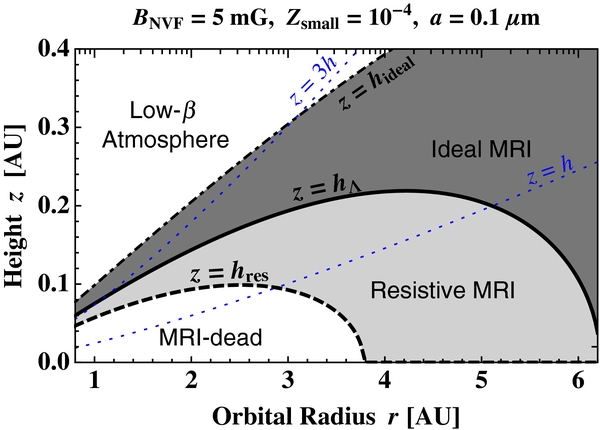
Figure 1. Example of the dead-zone size. The dot-dashed curve shows z = hideal for BNVF = 5 mG, while the solid and dashed curves show z = hΛ and z = hres, respectively, for BNVF = 5 mG, Zsmall = 10−4, and a = 0.1 μm. For reference, z = h and 3h are shown by the dotted curves.
Download figure:
Standard image High-resolution image3. ICY PLANETESIMAL FORMATION ACROSS THE FRAGMENTATION BARRIER
Planetesimal formation via direct coagulation is limited by the fact that marginally decoupled (Ωts ∼ 1, a ∼ 1 m) dust aggregates experience high-speed collisions that can lead to catastrophic disruption (the so-called fragmentation barrier; Brauer et al. 2008). If the disk is laminar, the maximum collision velocity is determined by the differential radial drift velocity ∼|vdr, max | ∼ 30 m s−1 (Brauer et al. 2008). Recent numerical collision experiments (Wada et al. 2009) show that aggregates made up of submicron-sized icy grains stick at collision velocities up to ≈50 m s−1, suggesting that icy planetesimal formation via direct coagulation is possible in laminar disks. However, if the disk has MRI-active layers, a random velocity of ∼δvg, mid is added to the collision velocity for Ωts ∼ 1 aggregates (Ormel & Cuzzi 2007). The question is: can icy aggregates grow across the fragmentation barrier even if the MRI-driven turbulence enhances the collision velocity?
To get a feeling of how the fragmentation barrier depends on dust size distribution and NVF, we begin with a simple two-population model in which large, marginally decoupled (Ωts, large ∼ 1) aggregates coexist with 0.1 μm sized small grains. We calculate δvg, mid assuming that only the small grains contribute to the ionization balance. The mass abundance Zsmall of the small grains is taken as a free parameter. Figure 2 shows δvg, mid as a function of Zsmall for different values of BNVF. For fixed BNVF, δvg, mid increases with decreasing Zsmall because the dead zone is smaller when small grains are less abundant. The thick gray line shows δvg, mid = 38 m s−1; above this line, the total collision velocity for two Ωts ∼ 1 aggregates, Δvlarge ∼ (δv2g, mid + v2dr, max )1/2, exceeds the disruption velocity vdisr = 50 m s−1 for icy aggregates (Wada et al. 2009). If BNVF = 1.1 mG, Δvlarge falls below vdisr for all values of Zsmall. The reason is twofold. For such small BNVF, a substantially large (hΛ ∼ h) dead zone is present even in the absence of small grains (note that hΛ is larger when BNVF is smaller). In addition, the small BNVF leads to a low saturation level in the upper active layer, resulting in a low gas velocity dispersion (note that δvg, mid∝BNVF when hΛ ≫ h/4). However, if BNVF goes up to 3.2 mG, Δvlarge exceeds vdisr for Zsmall ≲ 10−5, for which the active layer reaches the midplane (hΛ = 0). For BNVF ≳ 10 mG, Δvlarge exceeds vdisr even if Zsmall is as large as the interstellar value 10−2.
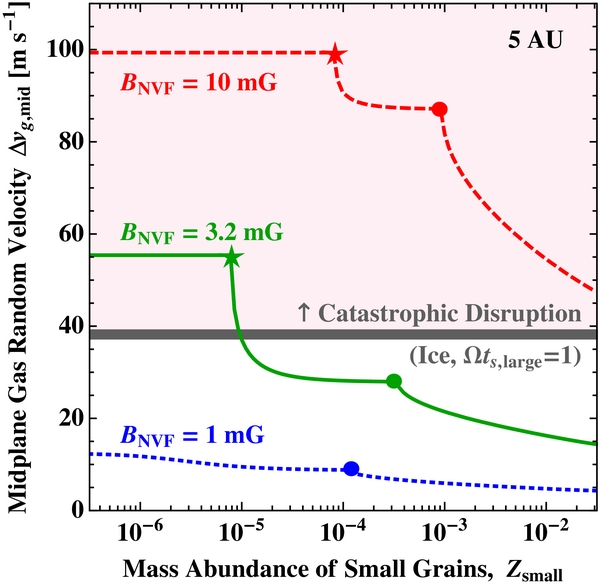
Figure 2. Midplane gas random velocity δvg, mid at 5 AU vs. the mass abundance Zsmall of small grains for different values of the NVF strength BNVF. The filled circles and stars mark Zsmall below which hres and hΛ vanish, respectively. Above the thick gray line, the total collision velocity for large (Ωts, large ∼ 1) aggregates exceeds the catastrophic disruption threshold for ice (Wada et al. 2009).
Download figure:
Standard image High-resolution imageFor BNVF ∼ 3 mG, large aggregates can grow across the fragmentation barrier only if small grains are sufficiently abundant. To show that it is indeed possible, we simulate the evolution of a full dust size distribution at 5 AU using a coagulation–advection–diffusion equation (e.g., Ciesla 2007). In this simulation, we begin with 0.1 μm icy dust grains well mixed in the vertical direction, and follow the evolution of the vertical dust size distribution due to coagulation/fragmentation and vertical settling/diffusion. The collision velocity Δv of dust particles takes into account Brownian motion, systematic drift in the mean gas motion (Nakagawa et al. 1986), and turbulence-driven random motion (Ormel & Cuzzi 2007) that depends on δvg. We take δvg to be time-dependent, namely, to be consistent with the dead-zone size calculated from the full dust size distribution (Okuzumi 2009) at each time step. The total dust mass abundance Z = Σd/Σg is taken to be 10−2, and the loss of dust materials due to the radial drift is neglected. Indeed, coagulation proceeds faster than radial migration if the dust grows into highly porous aggregates (Okuzumi et al. 2012). However, in order to make our model as simple as possible, we neglect both porosity evolution and radial migration. The mass of the aggregate after collision is given by mt + smp, where mt and mp(< mt) are the masses of the target and projectile, and s(⩽ 1) is the dimensionless sticking efficiency that depends on Δv. We assume s = 1 for Δv < 10 m s−1 and s = 1 − ln (Δv/10 m s−1)/ln 5 for Δv > 10 m s−1 in accordance with the result of numerical collision experiments for icy aggregates (Wada et al. 2009). The target loses its mass (s < 0) when Δv is larger than the disruption threshold vdisr = 50 m s−1. The fragments (whose total mass is (1 − s)mp) are assumed to be in the form of 0.1 μm sized constituent grains. This assumption is quite simplistic, but is still reasonable as a first-order approximation since the total mass of fragments in aggregate–aggregate collision tends to be dominated by the smallest ones (Wurm et al. 2005; Wada et al. 2009).
Figure 3 shows the simulation result for BNVF = 3.2 mG. The top panels display the vertical dust mass density distribution ρd per unit logarithmic particle radius log a at different times t after the initial state. Initially, dust particles grow without catastrophic disruption because of low collision velocities. As the particles grow, disruption becomes more and more significant, because the collision velocity increases with increasing stopping time and because the dead zone shrinks with the depletion of small grains. The second effect becomes prominent when t ≈ 560 yr, at which the dead zone disappears and consequently δvg, mid reaches 55 m s−1. However, the large amount of tiny grains produced by the catastrophic disruption are quickly diffused to high altitudes, reduce the ionization degree, and finally “revive” the dead zone. The revived dead zone suppresses δvg, mid down to 27 m s−1, which is low enough for larger aggregates to continue growing. In this way, the larger aggregates grow beyond the meter-size fragmentation barrier.
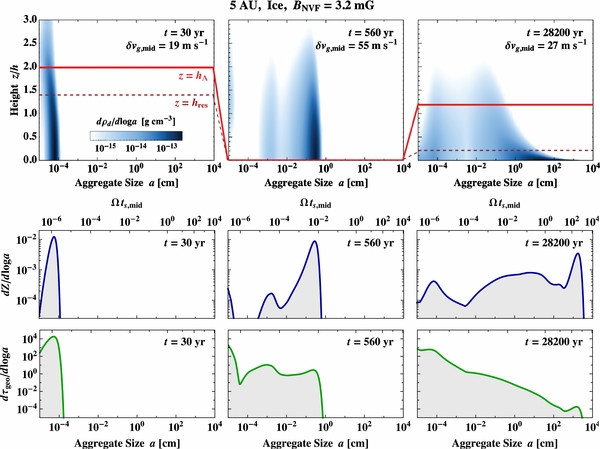
Figure 3. Result of a coagulation simulation for icy dust at 5 AU for BNVF = 3.2 mG. The top density plots show the dust mass density ρd per unit logarithmic particle radius log a at different heights z and different times t. The solid and dashed lines in the top panels mark the dead-zone critical heights z = hΛ and z = hres, respectively. The middle and bottom panels show the mass abundance Z and geometric optical depth τgeo of dust per unit log a, respectively. Shown in the top of the middle panels is the dimensionless stopping time Ωts, mid of the dust particles at the midplane.
Download figure:
Standard image High-resolution imageThe middle panels of Figure 3 plot the dust mass abundance Z per unit log a, while the bottom panels show the vertical geometric optical depth τgeo of dust per unit log a. We see that the dust mass is dominated by larger aggregates while the optical depth is dominated by small fragments. This indicates that small fragments carry a minor fraction of the total dust mass but still help the growth of larger aggregates by providing a large surface area needed to maintain a low enough ionization degree.
4. ROCKY PLANETESIMAL FORMATION VIA SECULAR GI
Coagulation of rocky aggregates is severely restricted by the fragmentation barrier since the disruption threshold is as low as 1–5 m s−1 (Wada et al. 2009; Güttler et al. 2010). Using that the radial drift speed |vdr| is approximated as 2|vdr, max |Ωts for Ωts ≪ 1(Weidenschilling 1977) and assuming that vdisr ≈ 5 m s−1 and |vdr, max | ≈ 30 m s−1, we find that |vdr| reaches vdisr when Ωts ≈ 0.08, which corresponds to a ∼ 10 cm at ∼1 AU. Hence, a simple coagulation scenario does not account for rocky planetesimal formation even without turbulence.
One mechanism that can lead to rocky planetesimal formation is the so-called secular GI (Youdin 2011). It is a gravitational collapse of dust materials driven by the combination of self-gravity and gas friction. An important feature of the secular GI is that it works even if Ωts ≪ 1. Thus, the secular GI can allow gravitational collapse of dust particles whose growth is limited by the fragmentation barrier. Instead, the secular GI requires sufficiently weak radial dust diffusion in order for the particles to collapse faster than they drift inward. For Ωts ≈ 0.1, the radial diffusion coefficient Dr must be lower than 10−5csh at the midplane (Youdin 2011; Takeuchi & Ida 2012).
To assess whether the secular GI operates for the fragmentation-limited aggregates, we estimate the MRI-driven diffusion coefficient assuming that the aggregates coexist with 0.1 μm sized fragments of mass abundance Zsmall. We also assume that Dr ≈ Dz, which is ≈Dz0 for Ωts ≈ 0.1 ≪ 1 (see Equation (3)). Figure 4 shows the midplane radial diffusion coefficient Dr, mid at 1 AU as a function of Zsmall for different values of BNVF. We find that Dr, mid exceeds 10−5csh for BNVF ≳ 10 mG even if Zsmall is as large as the interstellar value 10−2. Thus, the secular GI of the fragmentation-limited aggregates requires BNVF ≲ 10 mG. This requirement is similar to that for direct icy planetesimal formation shown in Section 3.
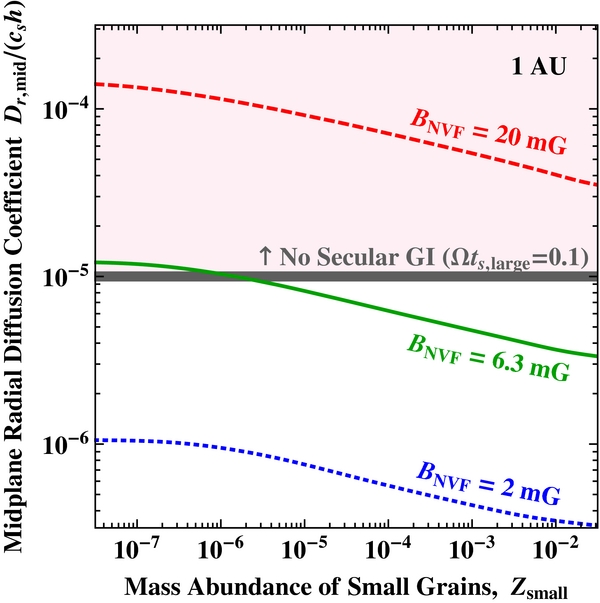
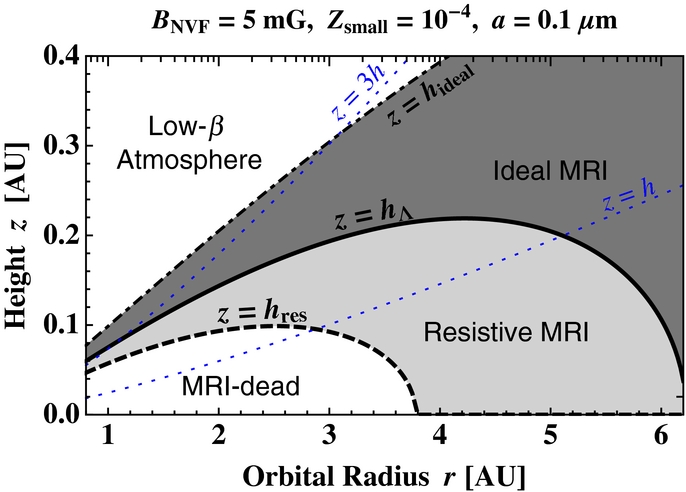
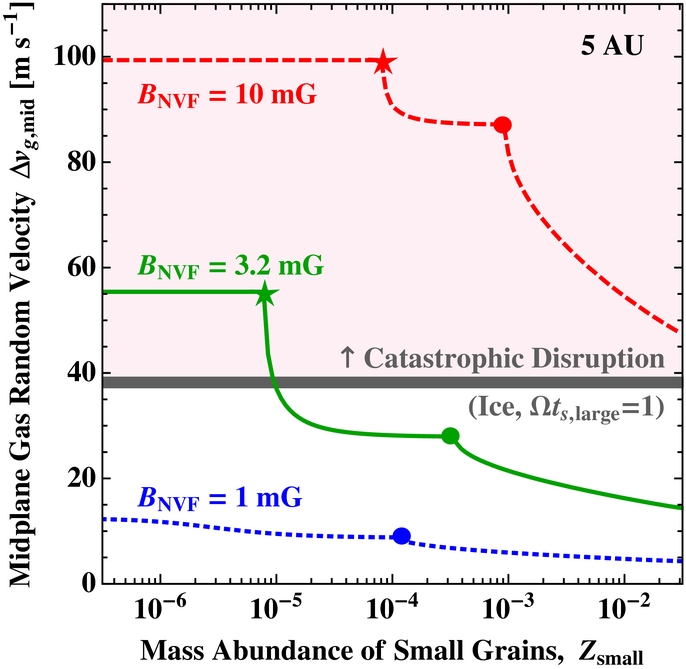
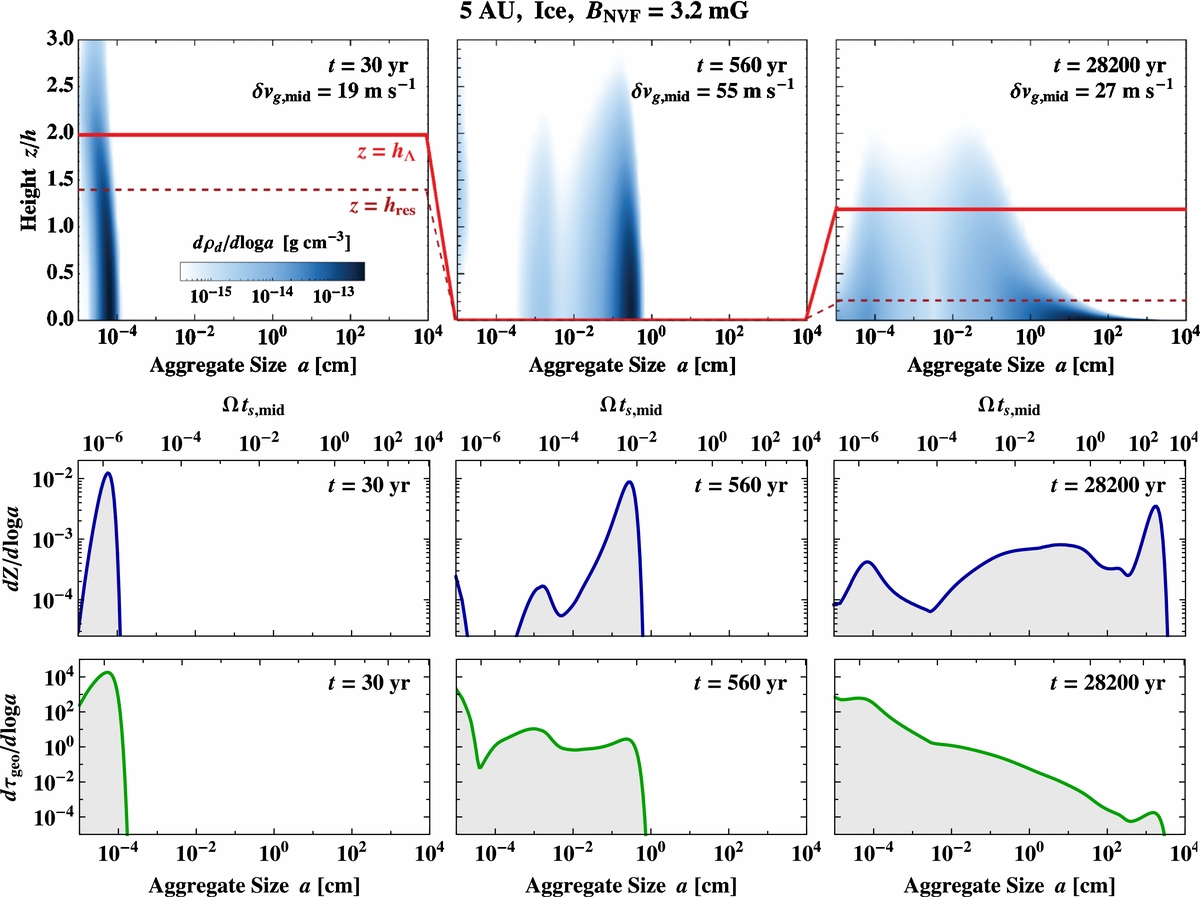
Figure 4. Midplane radial diffusion coefficient Dr, mid at 1 AU vs. the mass abundance Zsmall of small grains for different values of the NVF strength BNVF. Below the thick gray line, the fragmentation-limited rocky aggregates (Ωts, large ≈ 0.1) experience secular gravitational collapse faster than they drift inward (Youdin 2011; Takeuchi & Ida 2012).
Download figure:
Standard image High-resolution image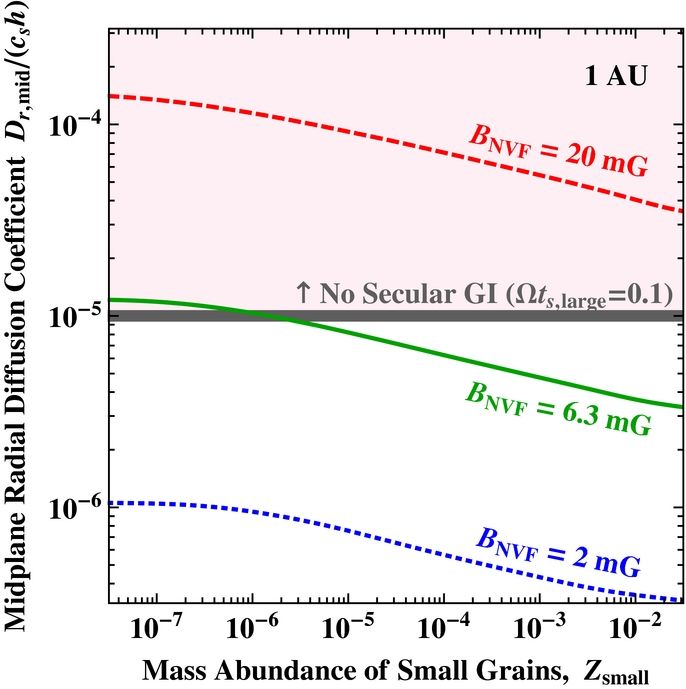
5. CONCLUSION AND DISCUSSION
We have investigated how planetesimal formation depends on the amount of tiny grains and the strength of the NVF. For MMSN disks, we have shown that the existence of a large dead zone and an NVF weaker than 10 mG is preferable for planetesimal formation via both direct coagulation and secular GI. The obtained criterion for the NVF depends on the disk surface density Σg, since δvg, mid∝BNVF/Σ1/2g in the presence of a large dead zone (see Equations (1) and (2)). If Σg is 10 times larger than the MMSN value, then the upper limit on BNVF goes up to 30 mG.
We have neglected the effects of non-ohmic magnetic diffusivities. Ambipolar diffusion may stabilize MRI near the upper boundary of the active layer (Bai 2011). The effect of Hall diffusion is more uncertain; it can stabilize or destabilize MRI depending on the sign of NVF relative to the disk rotation axis (Wardle & Salmeron 2012). Inclusion of these effects may change our results quantitatively, but the general trend that a weak NVF is preferable might be unchanged.
Weak turbulence is also beneficial to the growth of solid objects larger than planetesimals. Density fluctuations in turbulence gravitationally interact with planetesimal-sized objects and thereby enhance their collision velocity. If MRI is fully active, the resulting gravitational stirring likely causes catastrophic disruption of planetesimals (e.g., Ida et al. 2008; Nelson & Gressel 2010). However, Gressel et al. (2012) have recently shown that even weakly bound planetesimals are able to grow if a dead zone is present and if the NVF is weaker than 3 mG (assuming the MMSN surface density). Thus, a weak NVF and a wide dead zone are preferred for the growth of solid bodies up to protoplanets.
A realistic range of the NVF strength is poorly constrained by direct observations because the differential rotation of the disk can produce toroidal magnetic fields as strong as 0.1–1 G even inside the dead zone (Turner & Sano 2008). An important property of NVF is that the total NVF is a conserved quantity of a magnetized disk. Thus, the total NVF of a protoplanetary disk is directly determined by how the disk formed from weakly magnetized (∼10 μG; Heiles & Crutcher 2005) molecular clouds. Nevertheless, what fraction of the magnetic flux is brought to the planet-forming inner disk region is not evident because non-ideal MHD processes also work during the disk formation (e.g., Machida et al. 2011). Furthermore, on longer timescales, the NVF may be radially transported due to inward mass accretion (Rothstein & Lovelace 2008) and/or outward macroscopic magnetic diffusion (Lubow et al. 1994) in the active layers. So far, the origin and global transport of NVF has not been given attention in the context of planet(esimal) formation. We hope that this Letter will encourage further investigation into this issue.
We thank Shu-ichiro Inutsuka, Takeru Suzuki, Neal Turner, Masahiro Machida, Sanemichi Takahashi, Taku Takeuchi, Takayuki Muto, and Hidekazu Tanaka for useful discussion, and the anonymous referee for prompt and useful comments. S.O. is supported by Grant-in-Aid for JSPS Fellows (22 · 7006) from MEXT of Japan.